
Have you ever heard someone say “choose love over fear”? Or “choose to be happy”? Or the blasphemous “just choose to trust”? And you weren’t quite sure what that would even mean?
Or maybe you’ve tried saying “yet” and other growth mindset reframes, but it doesn’t really change how you experience yourself.
Or you read a book about inward and outward mindset, and that outward one sure seems better but it’s a strain to get in and then it doesn’t last and then you find yourself annoyed about the choices you made when you were in that other mode?
This article, for example, names four interesting mindsets including “scarcity mindset”, and offers some extremely mediocre tips for shifting. They’re not bad advice, but they’re not deeply grounded in how to actually shift mindsets, and quite misleading about how simple of a task it is, totally not recognizing the potential for inner conflict.
After 4 years of fumbling around in the dark and 1 year of concerted effort, I figured out how mindset choice works. It’s hard to overstate the significance of this to me personally—I spent much of my 20s trying to flip my mindset, then I had an insight in 2020 that made that whole approach seem confused, and I wrote up “Mindset choice” is a confusion. I knew at the time it was surely missing something—both conceptually and procedurally—but I couldn’t figure out what. Now I still stand by basically everything in that post, but also I now have a basic conceptual and actionable model of how mindset choice works. This is one of the most satisfying insights I’ve ever had, given this arc.
Deliberate worldview-scale mindset choice remains an extreme sport, and is also something that it is both rude and extra risky to ask someone to do without conveying to them a how, because naive approaches to it tend to lead to compartmentalization and so on. But it’s also powerful and has the potential to be incredibly beautiful. And with these principles, it’s not hard to play safely in the space.
This post will give a rough sense of how to approach choosing a mindset:
Essentially the mind is orienting to things in a manner that can be surprisingly well-described by a mashup of:
Consider the Necker cube:
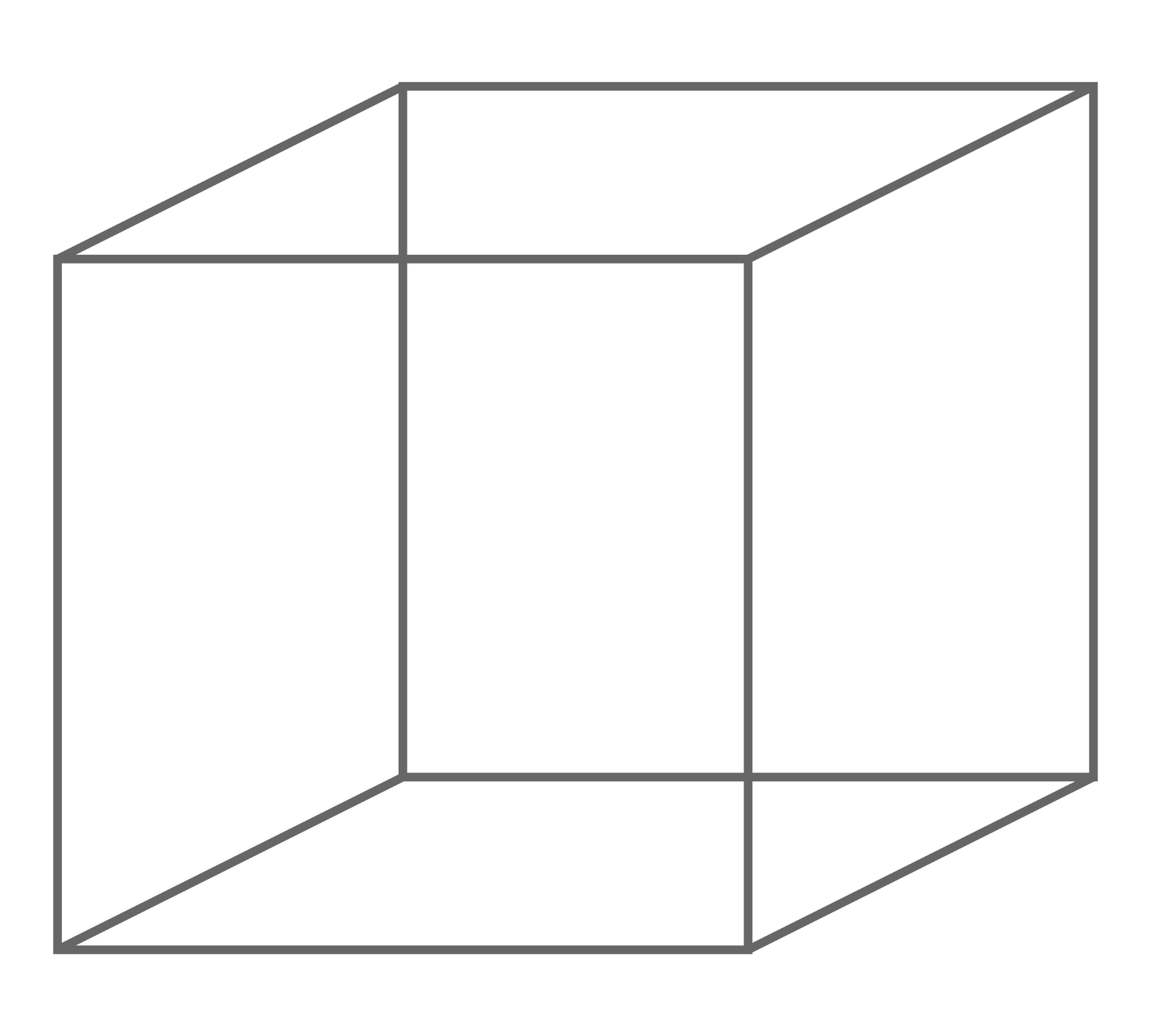
It has two viable ways to view it as a projection of a 3D object:
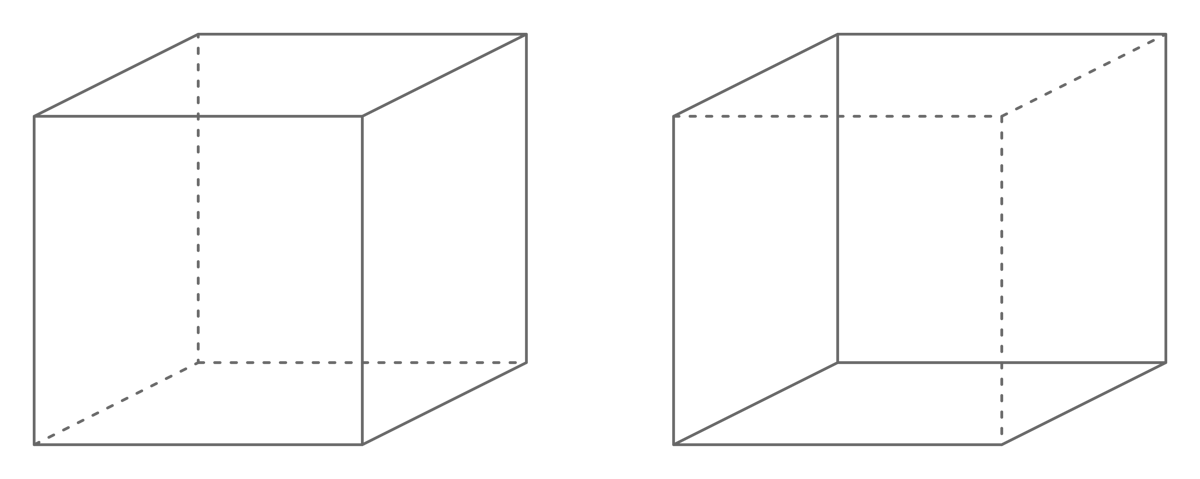
There are a bunch of sensemaking subsystems in an organism, and at any given time the obvious sense of how reality works is governed by some sort of ruling coalition between these subsystems. And coups between these have the bistable illusion property. These coalition dynamics happen on all levels of abstraction from visual perception of a specific image, as above, to “is this person cool or not?”, to deep self-vs-noself flips or religious (de)conversions. Faith is made of this.

These inner coalitions are also affected by outer coalitions. People who live in SF are going to tend to value traits that SF has more than others—whether hilly parks & beautiful architecture, or whether tech & cults—because the subsystems that care about those things are empowered by the activeness of the outer coalition of the agreement the person has, to be a member of the city. And this effect will increase to the extent that they’re committed to living in the city vs just happen to live there, including reversing if they’re there temporarily but committed to leaving.
Perception is made of both is & ought. If someone falls in love with someone who lives in a different city, the facets of them that resonate with the values/traits of that city, will tend to come into more salience. It’s not a matter of objective truth about whether that city is better; it’s about the skin-in-the-game that this particular person has, and how to view the world instrumentally etc—it is better to love this city more, so you want to appreciate the relevant aspects of the city.
Sometimes there are simple oscillations between one coalition and another. This is always constantly happening; this is business as usual. Minor shifts on these fronts happen simply by people talking to one friend vs another, their wife vs their boss… or because they are in a different mood or energy state, where certain features of reality or what they care about are more or less stable.
On other levels, things are not shifting. Some things change, but others are very fixed, and go unnoticed and unquestioned. Not unlike state-level governments!
While one coalition rules and ignores evidence it doesn’t like, the pressure of pieces of evidence that are not readily accounted for by the ruling coalition, can eventually build up strength in other subsystems. And yet the ruling coalition is still the other one. Then, whether it’s a religious (de)conversion or a breakup or falling in love or whatever—or even some intellectual insight—eventually there’s some piece of evidence that forces its way into consciousness, for whatever reason. Sometimes there’s a crisis of faith for a period of hours, days, or even weeks. But eventually there’s a kind of obvious “emperor has no clothes” moment where there’s a flip in perception. Like the Necker cube—it doesn’t gradually move from one to the other.
In retrospect, it becomes hard to even imagine how you missed the obvious implications of all of that evidence you’d been ignoring for weeks/months/years. Part of why this is hard to imagine is that some of the perceptual subsystems that are members of the former ruling coalition are themselves now being suppressed & ignored. So it becomes impossible to access the sense that the previous view made! Like when you flip the direction of the spinning ballerina but now you can’t flip her back.
Maybe this effect is very temporary—especially in the context of a simple symmetric illusion. But with religious (de)conversions, you might never get some of your old view back. There are things you KNEW, but they are too entangled with confusions that you’re now afraid of, so it’s too risky to be in touch with that knowing again.
Or maybe those old views are repressed for a long time, but then a decade later you have a subtle sense of something… missing. And you set out to recover them in some way where they can actually get re-included into your new view, or in a way where you find a new view that can include both. But it’s often hard to even notice what’s missing… because the whole view is maintained in part by you ignoring it.
How does that work?
Scott Alexander cites a guy named Byrnes, about a shared underlying process for both how to flip bistable illusions and how to enter into trance states:
The process goes:
Those steps—implementation details needed of course—answer the question of how to instantiate an inner coalition coup deliberately. There are changes in language, shifts in social expectation, and ritual acts: donning a mask, drinking the wine,. Lots of existing rituals implicitly involve these steps, and these steps also occur in the background of more subtle transformations. You could even say that how people get into a disinhibited party state involves these steps:
Having them as deliberate steps allows us to choose much more explicitly both where we’re going and how we get there, and design rituals or practices to induce such shifts. Which means that from our original checklist we’ve got “deliberately” covered, at a high level.
—hang on, that step 3 sure looks dangerous! Suppress evidence? How do we do it safely/sanely? And what about temporarily?
I’ve only done a few experiments with this so far, but one of the things I’ve done is have a time container for the whole thing: a timer, after which the old order resumes. This is especially important if the shift in view is intended to be the kind of potent thing that not only transforms your sense of what is, but also your sense of what has been—a common feature of religious-scale shifts. By bringing this into attention as part of the transition, in fact as something that is welcomed in step 4 rather than repressed in step 3, that means that the shift in coalitions gets enacted on the basis of its temporariness. So it may come to seem as if This World Is Forever And Has Always Been The Kingdom Of Heaven, but that view is granted in light of the idea that other views are also viable.
Reflexivity is about when the map changes the territory. This is meta-reflexivity—when the map of how the map changes the territory changes how the map changes the territory.
You can bake in temporariness in this way, but to the extent that you would like some shift, whether a religious conversion or a falling in love, to not be temporary, you will want to ensure that it is also sane. This is true in two senses:
What does sanity mean here?
I almost used the word “open-mindedly” instead of “sanely” or “safely”. But I really wanted to highlight that lack of open-mindedness here is dangerous and crazymaking.
Sanity means that first of all, you don’t suppress more evidence in step 3 than you need to. That eg in donning your company’s mission and worldview, you don’t lose the other priorities that you have in life and get sucked into having only one purpose in a way that later burns you out. The mission probably doesn’t directly imply that, but you might inadvertently do that in order to create the buy-in you feel you need.
Secondly, sanity means that evidence that does get suppressed in step 3 doesn’t stay repressed. That eg in donning your company’s mission and worldview, you don’t become incapable of listening to concerns or criticisms of its approach—ones bubbling up from inside you or coming to you from friends or family or the public.
Doing this kind of flip in a sane way means that instead, you can re-welcome and reintegrate all of this stuff, while continuing to experience your new worldview with stability.
That’s going to be partially a function of the view you choose, and partially a function of how you choose it.
Have you ever seen someone go through a religious conversion, or a falling in love, or a darkweb youtube conspiracy hole, or some other transformation, and afterwards they’re stubbornly deflective of obvious facts or relevances that would have been obvious to them before? It could be that they seem to deny observations or patterns about physical or social reality, or it could be that they deny what it was like or the concerns they had before the transformation—deny not just for them but for others.
(Of course it’s possible that you’re the one who doesn’t get it—the pre-trans fallacy, where someone who has transcended some view can look (to someone stuck in that view) like someone who doesn’t understand the view at all. But if someone can’t even articulate what their view was before, and reflect the sense it made at the time (aka “pass the ideological turing test”) then likely they’ve semi-permanently repressed those views, not transcended them.)
In terms of this 4-step model, it’s very obvious why the person can’t acknowledge these things from before—they’ve adopted a worldview whose stability depends on them continuing to suppress those things! So any other view reads to them as a threat.
It seems to me it’s possible to do something better.
Meta-reflexivity is again part of the puzzle.
Except this time, instead of the basis on which we’re adopting the new view being one of “I’m suppressing these knowings on the basis that this is temporary and I’ll come get them later”, it’s more like “I’m gently inviting them to step aside, only as much as needed, and on the basis that I’ll come back for them if they get lost.”. And part of how I make good on this promise is by recognizing facts like:
In other words, as part of the evidence that I make a point of including in step 4, I frame the view that I’m stepping into as one that benefits from the evidence I might temporarily lose by suppressing it in step 3.
There are views that you can’t step into like this—their whole means of stabilization requires denying this kind of meta-reflexivity and simply asserting that this is objectively the way things are and that anybody who doesn’t agree doesn’t get it, rather than allowing that this is one reflexively stable option for how things can be, and those who see it differently may be annoying but they’re also the crack through which the light is trying to get in.
I’m talking here about this as something I do, but this is not a skill I’ve yet had much practice with. Aspects of it are core to the philosophy I’ve had for 5 years, but the stuff about deliberately choosing to shift views in this way is new as of the last few months, and was in fact something that this philosophy had itself been hostile/repressing towards. So it’s still mostly untested, and I’m sure once I experiment with it more I’ll develop both more inexplicit skill and more explicit models that I can articulate, and I’ll see ways in which my current model is incomplete. This anticipation is itself kind of an example of this open-mindedness.
The cool part about this is that minds like to be sane,
I have only very vague ideas for how to actually translate these insights about meta-reflexivity into something like a large group ritual or coherent religious group. I need to do a lot more experimenting. My handful of small-scale experiments with 2-6 people so far have been quite promising though! This top-down vibe-shifting process also works for an individual but when done as a group it can be much more rich and surprising and stable because the shared expectation of each other making the shift creates an outer-scale top-down force that reinforces the new view.
Part of the challenge, so far, has been in simply getting a shared picture of “where are we aiming for?” What view are we aiming to experience together? Are we aiming to bless an object in some way, so that it has some particular effect? Are we aiming to cultivate an upward spiral dynamo of hope in some care attractor or shared mission? Are we aiming to change our very sense of the fabric of reality, from whatever it ordinarily is to something different—a dream, a simulation, heaven, alive?
Once you have the aim, mutually reinforcing that view becomes a viable possibility, although it still involves focused attention and trust and creativity and some amount of patient play, to reinterpret everything that’s happening in light of the new view.

Constantly consciously expanding the boundaries of thoughtspace and actionspace. Creator of Intend, a system for improvisationally & creatively staying in touch with what's most important to you, and taking action towards it.

Have your say!