
Epistemic status: I’m definitely onto something but don’t take my word for it.
There sometimes seems to be a tradeoff between confidence and humility. That apparent tradeoff comes from a subtle assumption, which is common yet false: that your experience and mine are supposed to be the same. Rudyard Kipling knew this:
If you can trust yourself when all men doubt you, yet make allowance for their doubting too.
If, indeed. If we could do that, that’d be great. But how?
Consider these five expressions:
They’re all expressing a concern that the person is trying to screw you over. That part of the sentence doesn’t even change! What I’m going to say also applies to other second-halves of the sentence: “going to hurt me” or “lying” or “asking me to doubt myself” or “hiding something” or “overoptimistic” or “not on my side” or basically anything. I deliberately picked a contentious situation—one where it’s hard to talk without encountering issues. It’s contentious not just because of the tension in screwing-over, but because they refer not just to the other person’s behavior but their intent.
These phrases all express the same concern, but they express it in vastly different ways. They’re radically different speech acts—nearly as different as “what do you think about getting married?” is from “will you marry me?”. This isn’t just about the words, although words can help us understand how confidence and humility are not opposites but how you can have both or neither.
No transcending of a duality is complete without a 2×2:
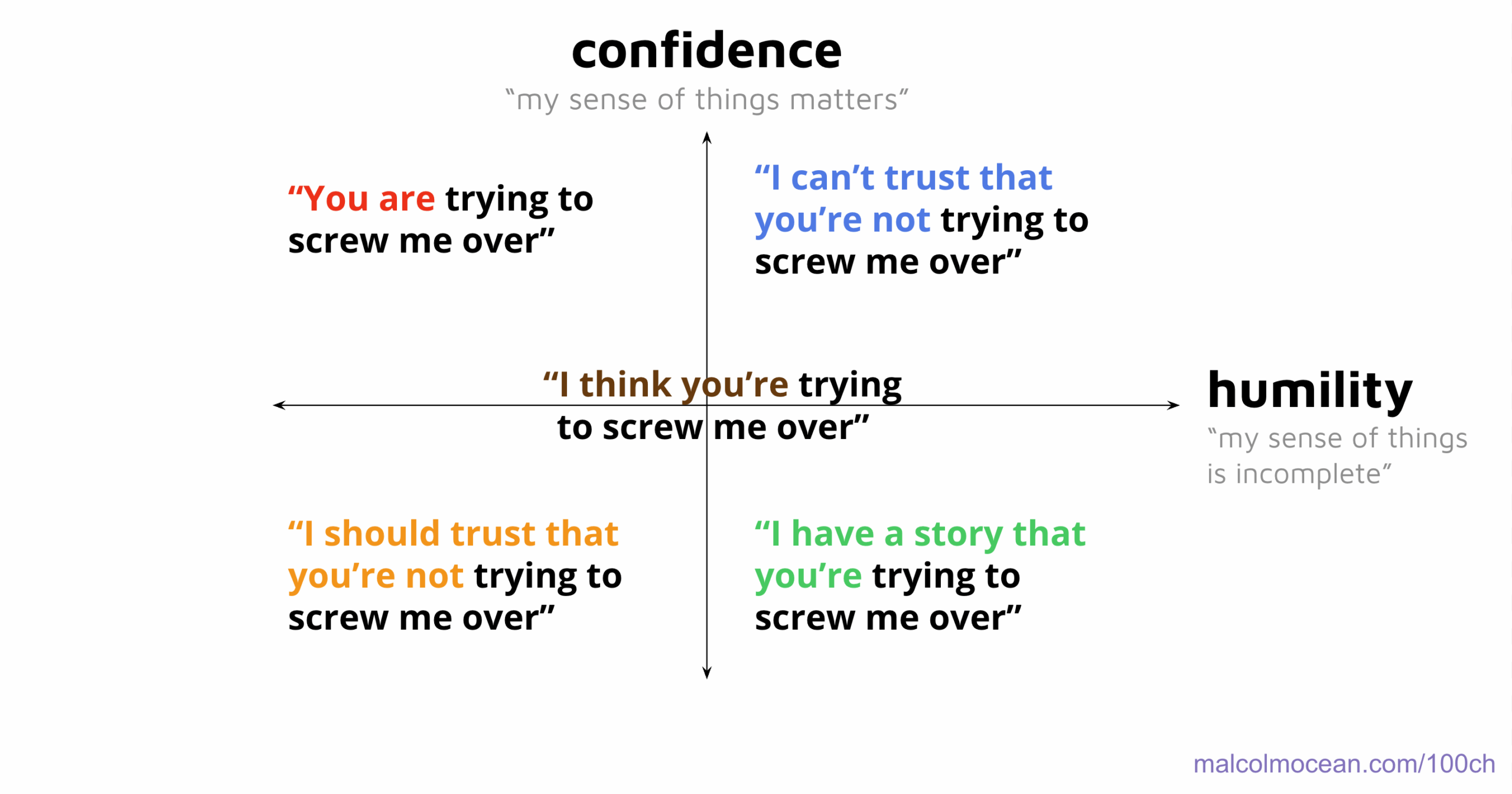
Let’s talk about each of these different kinds of speech acts in turn.
This one is all confidence and no humility. In general this speech act is a claim, but in this context of talking about someone’s intent, this speech act is an accusation, which invites defending—or, if the accuser has sufficient social power, capitulating. Where the others are “I statements”, this one just tells it how it is. Except of course I don’t actually know how it is, I only know how it seems to me. This is especially true with statements like this one, which imply something about the other person’s intent.
Suppose that you’re indeed doing something that is likely to screw me over, but without intent—you don’t have any idea that I have a particular vulnerability, eg a peanut allergy or some information I don’t want public, or whatever. You’re going to have a hard time syncing up with “You’re trying to screw me over”. You’ll probably just say—rightly—“no I’m not!” But I’ll still be left with the sense that you’re gunning for a future where I get screwed over.
If you’re on your game you might be able to reflect back “I’m not trying to screw you over, but what are you worried about happening? Maybe I’m missing some way in which what I’m doing is about to screw you over.” And then we might be able to resolve things. But it really demands a lot from you to dodge the accusation and respond in a sense-making sort of way. Because if you just say “no I’m not” then you’re basically accusing me of a false accusation and we’re into a caustic game of “he said she said”.
Suppose that you have some subsystem that is trying to screw me over, but you have no conscious access to that subsystem—in fact, it’s something in your shadow or blindspot, that is actively trying to hide itself. If I accuse you of trying to screw me over, the “you” that I’m talking to is not trying to do that, so once again you’ll be inclined to respond “no I’m not!” But the “you” that I think is trying to screw me over includes this other force in you that is trying to screw me over, so your “no I’m not” is speaking on behalf of a misleading “I”. But once again, it’s hard to respond any other way. It is possible though—sometimes I’ve said to people “well, I’m not aware of any part of me that wants that, but I imagine if there were such a part it might be hidden, so I’m not sure”. I’ll generally add further remarks encouraging them to listen to their distrust—more on that below.
Both the “no I’m not” and the “I’m not sure” look fairly similar to how you might respond if you were actually knowingly trying to screw me over, and were simply denying it! And the fact that we both know this also sort of make it easier for someone to hide their malevolent intent by shifting the argument onto the unjustifiability of the accusation—which is a layer remove from the actual question of what’s going on.
After all, I have said something that’s kind of an overreach: I attributed motives to you that I can’t directly know, and so when you point out that I can’t know what your intent is, we might falsely conclude that therefore I should trust you… and thereby slide into the gaslit quadrant described below. This can happen independently of whether you’re actually consciously or subconsciously or not-at-all trying to screw me over.
Even if there is a friendly resolution possible, if I open with this accusation, there’s a decent chance we’ll end up not finding it and I’ll end up concluding that I was right all along.
Meanwhile… if I’m making an accusation about your motives and I have any sort of power over you, then there’s a chance that even in a situation where your motives are good, you’ll end up doubting yourself and obsessively trying to extricate any parts of your motives that are less-than-wholesome, even if they represented approximately none of what was actually going on for you in the moment. This is capitulating to an accusation, and results in you being blamed—that is, we explain our problems only in terms of what you’re doing, and our attention is directed clear away from whatever I might be doing that makes the situation weird or tense or hostile.
Other phrases from this quadrant:
This quadrant directly speaks to the common sense of things, and if it’s allowed to stand then it changes the shared sense of what is so.
Some people will find that the directness of this quadrant is more tractable than the one I’m about to talk about, even though it encounters these issues of defensiveness, because it at least brings everything forth. This is more true in more arms-length domains where such statements are simply claims rather than accusations, eg if talking about whether a particular strategy or policy would work, compared to talking about someone else’s intention. It’s even easier with math or science or engineering, where we can mostly keep ourselves removed from what we’re talking about and simply say phrases like “that’s not going to work”.
This one is all humility and no confidence. I’m making no bid that I get to say what’s actually going on between us. I’m… telling you what’s going on “in me”, and you can choose to treat that as me being crazy or deluded or whatever. This speech act is often called “owning one’s experience”, and at its best, it invites perspective-taking. But it can also invite dismissing or psychoanalyzing.
Saying “I have a story” creates a kind of space. I’m saying how I see it, but I’m not asking you to agree—you can have your own story. Here’s “agree to disagree” land. It also implies I could have other stories too, and that this is just one of them. Good for not ruffling feathers too much, and papering over real issues.
This mode can be transformative, which is why it’s frequently recommended by books and courses on how to communicate better, from Circling to Landmark Forum and beyond.
A great example can be found in this short article and worksheet from counselors Marlene & Bob, about how to “Speak the Unarguable Truth”. They recommend starting with observations about the world that are framed in a neutral way, then sharing bodily sensations with minimal narrative, and then finally sharing “interpretations”, which have this “I am making up a story” or “I imagine” frame. You can’t argue with how my body feels, and you can’t argue with the reality that I have a story. Their framing accords with the meta-protocol vibes of “there’s no right answer, just what works” in that they say:
How do you know that it is unarguable? You don’t get an argument back. If you are getting an argument in response, then you likely haven’t gotten to the unarguable truth yet. There is usually another layer of truth that you can access.
When the revealing of the story produces surprise and curiosity for the other person, this is owning one’s experience working well. Saying a more detailed and personal story than “you’re trying to screw me over” might help with that, as it really makes it clear the extent to which the story is very much something going on for one person and not the other, who would never have remotely considered conceiving of things in those terms. And then you get to satisfying resolutions like “Wow, yeah, if I’d known all this context and why you care so much about this, I would have been much clearer about what I was up for. And I will be going forward!” And the new sense of things lands for everyone involved.
But often this is not what happens.
Once again, suppose you were actually doing something that is likely to screw me over, but don’t know it, whether because you’re missing information or because the subsystem in you that has a screwing-me-over strategy isn’t available to the parts of you that I get to talk with. In either case, if I reveal my story…
And once again, we will note that these responses are just as usable by someone who is actively, knowingly, consciously, trying to screw me over. They’re broadly symmetric weapons. Which means that they will tend not to build trust—at least, they won’t build non-naive trust.
On the psychoanalysis track, it’s possible that investigating the origins of my story causes a spontaneous mismatch experience, where I notice some way in which I’ve been viewing this scene is totally not relevant. You can tell this has happened because it will feel like a simple relief, and sometimes funny. “Haha wait what? I was concerned that you would be mad at me if I spoke my mind? That’s… yep, I really was worried about that until I looked at it, but now that I have, and I compare it with what I know of you, and that just really doesn’t feel likely here, since you always favor directness. Well, that makes sense!” It may be more painful than funny. But it feels obvious and clarifying.
If instead the investigations yield a tentative sense of “I guess it’s this”, then that’s almost surely not it. It might be part of it, or it might be a complete red herring, but if it doesn’t feel like “oh of course” such that it makes total sense why you were concerned and you can see now why it’s not an issue… then there’s some other concern that hasn’t been noticed. That’s what it feels like to rotate your inner coalitions to repress a view.
As I mention in Dream Mashups, just because I’m projecting something on you doesn’t mean I’m the only one who can do anything about it. You have the power to find some way to act that would be incompatible with my projection.
Other examples of the owning one’s experience / story quadrant:
This one, it seems to me, attempts to strike a 50/50 compromise of humility and confidence. I’m not saying definitively that you are trying to screw me over, but I’m still kind of asserting it as something worth considering. It shows up in the spirit of truth-seeking, voicing a concern into the shared understanding space while not withdrawing my “I” from the mix. This speech act is a proposition.
As a proposition, it invites considering whether the proposition is true—something in the realm of truth-seeking, debate, argument. If I think X, and you think not-X, then we disagree! We might assume therefore that one of us is right and the other is wrong. Or perhaps it turns out the truth is somewhere in between, or we’re both confused. Maybe we even know about higher dimensional thinking, and so we try to resolve the paradox between our two views!
“I think it’s going to rain tonight” is the sort of thing to which someone might respond “actually I checked the forecast and the storm is supposed to blow past us to the south”. And this makes sense to the other person and things are resolved.
In a mostly-useless sense, “I think that” is also unarguable—it’s hard to argue that I don’t think what I think—but in practice of course we treat “I think that” statements as being primarily about the proposition. So the usual response is to try to investigate the proposition, whether via debate or via inquiry… sorting through the details of what it means and whether we agree. Unlike the un-stemmed “you are” above, implied here is that even if I’ve mostly made up my mind, my thoughts are in principle open to being influenced by evidence, argument, etc.
Other ways that people express propositions include:
Success at this register of exchange requires some combination of the situation being a simple misunderstanding or us to be skilled at clarifying and giving each other the benefit of the doubt—the kinds of moves described in elements of rationalist discourse, though not necessarily consciously or based on a list. It gets extra hard if you’re in a situation where there’s a lot of tension about the kinds of frames we’re using and the kinds of evidence that are relevant.
I said that “I think” is sort of a 50/50 compromise, but exactly where it falls depends on the situation and the tone, and it can end up looking much more like a story or an accusation depending on those, and falling into similar pitfalls. But if we stay in the middle, then this ends up neither really being about what my story says about me nor what my accusation says about you, but just a matter of sorting out what’s so.
What’s nice about this compromise is that it at least attempts to seek common ground, not demanding that someone agree or defend, but inviting them to make their case. However, you can still run into situations where the underlying energy ends up being one of “look I know you think that I […] but you’re wrong.” And implied in that is usually some amount of “and since you’re wrong, you should trust me.”
But the whole issue is that…
As far as I can tell, this manages to max out both confidence & humility at the same time. I’m owning that my distrust is mine, and not accusing you of anything, but I’m also presencing into the reality a social fact: that I cannot non-naively trust you, given what I know. It’s not just a story I have, and it’s not just an opinion. It is my best sense of what is going on and what I can rely on. This speech act is… well, I call it non-naive trust-dancing. Or more narrowly, revealing-distrust.
It invites recognition and respect of distrust. Even if you know you’re not trying to screw me over, we can get on the same page about the fact that I don’t—and this is a fact, not just something I’m imagining or a thought that I’m having. If I could trust you more, I would, but I can’t, so I don’t. The reason why this is so powerful is that there’s a very immediate need for conversational/relational shared reality to track is people’s trust in each other, so sharing distrust is of a different type than sharing a story or thought or feeling.
Another way to put it is “there’s a way I would feel if I weren’t worried about you trying to screw me over, and I don’t feel that.” This is more verbose but it’s also more precise, and it is, I think, synonymous with what people often mean when they say they distrust something or someone. Since I don’t trust you in a whatever way, I have to take appropriate precautions whether physically or psychologically or whatever—obviously. Which might mean guardedness or distance, or could simply amount to checking that I could recover from whatever betrayal I’m worried about.
The fact that it’s a double negative is vital to it being as powerful as it is. You can argue it’s complicated, to which I will argue that it’s no more complicated than the situation it’s attempting to describe. Being in a situation that involves distrust means being in a non-simple situation—especially if there’s some pressure to trust in some way that you can’t. There are competing senses of what’s going on.
In the magical ignorance wisdom of Unforeclosing statements, I highlight the difference between:
The former is clearly “fightin’ words”, whereas the latter creates space for the absence of knowledge to be filled in. That creating of space is what I call “unforeclosing”.
Here’s another phrasing, still unforeclosing but different: “if you aren’t trying to screw me over… well, I can’t tell.”
The best assertional phrasing I can find for this quadrant is “it seems to me that you’re trying to screw me over” — you’re directly talking about not just your thoughts or stories, but your very sense of the world. So if someone tries to argue, but it doesn’t change your sense of things, then you can say “I hear that but it doesn’t change how things seem to me.”
The issue with saying “I don’t know you care” is that the word “know” here tends to sort of still imply that the care is present. Like it’s available to be known, I just don’t know it myself yet. Whereas “trust” leaves that question open as well. “I don’t know if you care” sort of fixes that, but then tends more towards implying a binary yes/no, with a single ground truth, a single propositional fact-of-the-matter about this care, that I could know or not know. “Trust” makes it more clear that I’m talking about my relationship with your care.
Maybe this is different in other languages, maybe it would have been different in English hundreds of years ago. In any case, I am communicating here and now. So here I might say “I don’t trust that you care”, or “I can’t tell that you care” or perhaps, equivalently but more verbosely “I don’t have what I would need to know that you care.”
When I talk about trust, I’m generally talking about something I’ve been calling “non-naive trust”. A more precise phrase for it might be “uncompartmentalized trust”. It’s trust that comes not from repressing distrust but from honestly doing the dance to build the trust. It’s the kind of embodied ease you have in relation to people and situations that make sense to you and your skin-in-the-game—ease that you can’t control, that emerges naturally and obviously from your sense of “I can tell for myself”. Pretty much everything else that gets called “trust” amounts to some kind of pretending or forcing. You can’t directly choose to trust (or to distrust) in this sense, but you can bring your sense of trust in contact with new information (or old information from a new angle) and see how it shifts and evolves.
If someone says to me “well but you should trust” then I simply say “ah but I don’t—shoulding something doesn’t make it so”. If they say “just choose to trust” then I simply say “ah but I can’t—I could maybe pretend, or keep my distrust while choosing to take the sort of risk I’d take if I did trust, but I can’t trust what I can’t trust”. Trust cannot be conjugated in the imperative.
Therefore I use “can’t trust” and “don’t trust” pretty interchangeably, because when it comes to this kind of trust, you always do trust what you can trust, and don’t trust what you can’t trust. So these are synonymous.
If parts of me trust and parts of me distrust, the only honest thing I can say about me-as-a-whole is that I don’t trust. To try to trust is to try to slice off the part of me that doesn’t trust. Thus honoring distrust is an inherently integrative move.
As with all of these, it’s partially about the stance and tone, not just the words. And of course, sometimes people find it very uncomfortable to not be trusted, so they might push back anyway. But this quadrant gives the best shot of getting serious shared reality in tricky situations, especially where both people have a lot of trust in their own experience.
So if I say to you “I can’t trust that you aren’t trying to screw me over”, you might not like this, and it might threaten your identity if you think of yourself as trustworthy. And you might have trouble imagining how it could possibly be the case that I don’t trust this about you, given that you’d trust it about basically everybody in situations like this. But nonetheless—unless you don’t trust that I’m not straight up lying—it’s not that hard to accept that (for whatever reason) I’m not able to access that embodied ease here. There’s a good chance I even want to trust you here, and it might be helpful for me to say that I’d like to build that trust. And you might not understand or agree with whatever narrative I have about it—whatever story or language or whatever—but that’s sort of just the surface level.
The inescapable unshakable fact is that, at this moment, the trust isn’t there. That doesn’t mean that you should distrust yourself—your trust and my trust are different, obviously. There’s nothing to disagree about here!
When I’m grounded in my sense that I trust you as much as I do, in the ways that I do—no more, no less—then if you try to argue with me about why I should trust you, or psychoanalyze my distrust or whatever, I have plenty of space to explore with you in whatever directions, while knowing that I’m not going to get tricked out of my distrust by some clever line of reasoning or introspection.
But more importantly, when you’re also grounded in this sense—when together we both are letting the trust unfold how it does and not trying to force it—there’s clearly little point in arguing. You might want to share your perspective to see if I’m able to trust you more once you let me in, but there’s no sense that it should convince me—we’re both just there to find out. And to the extent that we’re doing this, the whole experience tends to become exquisitely playful as long as there’s not some high-pressure decision that hinges on the outcome (or some giant sunk cost we’d have to lose).
And this is conscious trust-dancing. We’re always in the dance of our trust for each other, and in some sense we’re always revealing exactly how much we trust each other, but sometimes we’re trying to pressure ourselves or each other to fake it, to adopt an unquestioning attitude in a situation where that feels unsafe or unwise. And when that becomes a habit, we end up with bizarre twisty responses like…
It took me awhile to figure out what goes in the bottom-left quadrant. It’s clearly the worst of all worlds. But it ended up being simple to find: take the self-evident wisdom of the top-right quadrant, and say that it should somehow be not how it is. Making such a move, I am not confident, because I’m negating my own sensemaking… but I’m also not humble, because I’m assuming a particular conclusion is correct.
If I say this “I should trust”, the obvious actual subtextual content of what I’m saying is still that I can’t trust that you aren’t trying to screw me over—otherwise I wouldn’t even feel the need to say this—but then I’m just completely betraying my own perspective and turning it over to the authorities for arrest. This speech act is self-gaslighting.
The authority in question may be the “you”—who I don’t trust!—or it may be a superegoic injunction from my mom or a spiritual teacher or some memeplex. It may have a specific target, eg “you should trust adults” or “you can trust Bob”, or it may be generic, eg “it’s wrong/sinful not to trust”. Regardless, in holding this stance, I have swapped out my trust, my knowing, my sense of things… for someone else’s.
The self-gaslighting invites a kind of narrative domination from the other, which is tricky to get out of—a bit of a double-bind. If you agree—“yes, you should trust me!”—then you agree that I should doubt my own knowing. If you disagree—“no, you shouldn’t trust me”—then you’re still positioning yourself as the authority, and moreover you’re giving off a weird twisty message around your trustworthiness. Whether or not you trust me, given whatever information you have, is not up to me.
If you want to support the person’s self-trust / “I can tell for myself” sense, you’re doomed if you respond in the “should” part of the frame. But there are plenty of available moves that can help the person shift from self-gaslighting towards their “I can tell for myself” sense—to tap their self-trust and get into the humble+confident stance. Depending on context, I might respond to “I should trust that you aren’t trying to screw me over” with phrases like:
More on this in “trust” can’t be conjugated in the imperative case.
Each of these does some mix of:
A lot of the responses I gave above are also pretty close to how I might respond to people coming at me from the other quadrants, although of course many of them have to be phrased slightly differently if they haven’t already used the word “trust” such that I can reflect it. But ultimately they’re all a way of differentiating between our two viewpoints and acknowledging that things actually seem the way they seem to me to me, and that they actually seem the way they seem to you, to you. And that that is how it is!
A more common way that the self-gaslighting gets expressed is “I know you’re not trying to screw me over”, because the fact that it’s being said is usually precisely because you don’t know that—you cannot tell for yourself. If you could tell, it wouldn’t even be coming up, and if someone else brought it up maybe you’d say something more like “yeah I’m not worried about that”. So this “I know” is an attempt to ally with some social process that says that I’m supposed to agree that you’re not trying to screw me over, not an actual statement of clear direct-knowing. Other ways that people self-gaslit here:
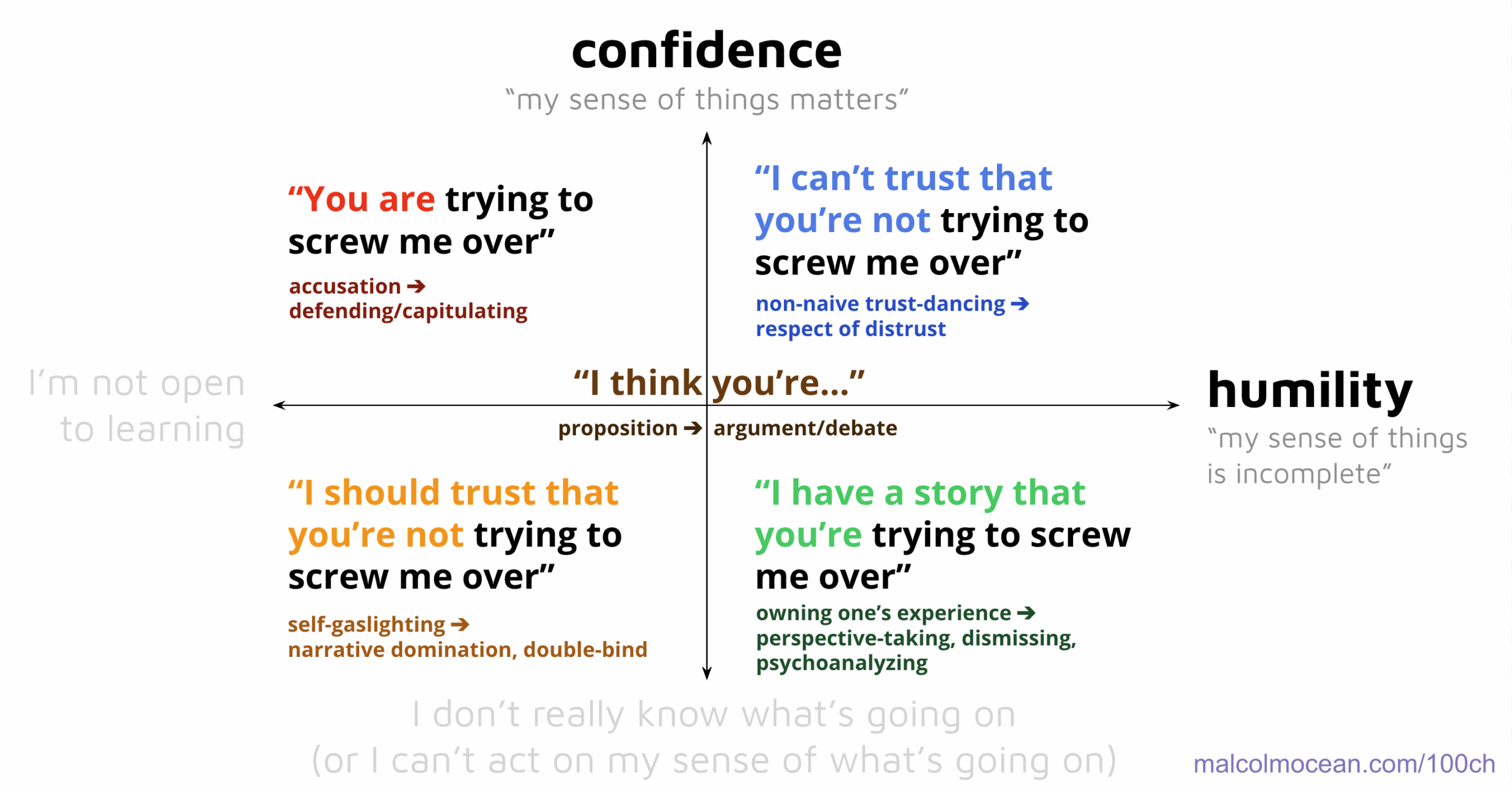
To this image, I’ve added the names of the kinds of speech acts, plus a description of the opposites of confidence and humility.
Below are a few quick other examples for flavour. Again, don’t take the exact words too seriously, just pay attention to the stance.
“I’ll be here at 7pm”
On care:
Ok…
Is that so?
Okay, so you’ve got a car—
This means meeting people wherever they speak from, receiving the content of what they’re saying, and responding back with something that encourages their sense-making and collective sensemaking, where that’s possible. I gave examples of this in the section on the self-gaslighting quadrant.
If you’re dealing with a slippery complex situation where there’s something you want to talk about but the mere idea of bringing it up gives you brainfog, you might appreciate my template for conversations about blindspots: How To Gently Blindly Touch the Elephant In the Room Together.
If you’d like some general guidance for how to navigate these dynamics in the moment, check out 3 Steps for Empowered Dialogue (3SED).
If you want to better see the precise thing I’m calling “trust”, and understand how it works, the best pieces are probably:

Constantly consciously expanding the boundaries of thoughtspace and actionspace. Creator of Intend, a system for improvisationally & creatively staying in touch with what's most important to you, and taking action towards it.

Malcolm » 7 May 2026 »
I left this comment on The map of the map is not the map by jimmy on LessWrong, and I thought that the comment would also be a helpful elaboration here. I’ll put a larger blockquote here for context.
It is raining, but I do not believe that it is raining
To say, simultaneously, that it is raining and that we do not believe that it is, sounds absurd. It is absurd, because it is transparently contradictory.
Unlike “I know I’m not in danger, yet I feel afraid”, which sounds totally reasonable. Heck, I’m pretty sure we’ve all been there, even. Maybe you know that the rope will hold you, but you’re still afraid it will break.
The bolded part above is part of why I get a lot out of the word “trust”, which cleaves the second half of that very cleanly across more situations than having to tag a particular emotion in contrast with a thought. It’s just referring more
Your trust is the map that forms your actual sense of reality. I was going to say “the map that you’re steering by” but that’s incorrect; lots of people who are scared of planes still fly in them. But your trust is what you can tell for yourself is so. Someone who thinks they shouldn’t be afraid of planes but still is, is attempting to take someone’s word for it that planes are safe, which doesn’t produce trust. Whereas the same words from someone else can under some circumstances cause someone to notice “huh, I know several people who’ve been in car accidents, but I don’t actually know anybody who’s been in a plane accident” at which point it starts to affect their bodily sense of things.
But yeah, “I know I’m not in danger” is misleading here because it’s ambiguous whether it’s supposed to be about your actual embodied trust vs (what it actually is in this case) your internalized conceptual model made up of stuff other people said, that you think you should believe but on some level don’t know how to integrate with your actual sense of things. In practice, ironically, people usually only say “I know X” when they actually don’t trust X but have some reason to think that they should.
Trust is what truth feels like in first-person. When something in fact is true we just assert it: eg we just say “2+2=4” not “it is true that 2+2=4” (unless we’re specifically trying to do predicate logic). Likewise, when we trust something, by default we don’t emphasize our trust in it, we simply say that it is fine. “Travelling on planes is safe”, we say, not “I know travelling on planes is safe”. “I know” protests too much in such situations. (The only situation in which it doesn’t protest too much is when you’re not emphasizing the “know” but the “I”—if you don’t know that there are an infinite number of primes, and I do, I might say “well I know that”. Although for interpersonal situations like “Jack would never crash a car” I would still recommend “I trust” over “I know”, for reasons described in 100% confidence + 100% humility.)
And maybe also we acknowledge the lingering discomfort with “I feel a bit of a loss of control when I’m trapped in a box I’m not steering, knowing that if there were a problem I wouldn’t be able to do anything about it. But I don’t expect there to be a problem.”
Have your say!