
I would like to give a caveat that this whole essay is more reified and more confident in what it says than I would like it to be. I am currently finding that I need to write it that way in order to be able to write it at all, and it longs to be written. I should probably write this on all my posts but shh.
I observed to my friend Conor that for a given conversation you can ask:
what forces are running this conversation?
In other words, you can treat the conversation as having a mind of its own, or a life of its own (cf Michael Levin; these are essentially the same thing). It has some homeostatic properties—attempting to make it do a different thing may be met with resistance—sometimes even if all of the participants in the conversation would prefer it!
From here, you can ask:
if the conversation has a mind of its own, what is that mind’s relationship with the minds of the individuals who make up the conversation?
(Note that “conversation” here spans everything from “a few people talking for a few minutes” up to Public Discourse At Large. A marriage or friendship can also be seen as an extended conversation.)
This lens provides a helpful frame for talking straightforwardly about the ecstatically satisfying experiences of group flow that I had as part of an experimental culture incubator in my 20s, and why I came to view those experiences as somewhat confused and misleading and even somewhat harmful—while simultaneously, I don’t regret doing it, and I maintain that they were meaningful and real! (And re “harmful”—we talked at the time about it being an extreme sport, so that’s not an issue in the way it would be if it were advertising itself as safe.)
My previous post, Conversations are Alive, began its life as a short intro to this post, but it got so long that it needed to be its own post. It describes many kinds of ways that something can be in charge of a conversation that’s not any one individual in it, but an emergent dynamic. What begins as bottom-up emergence becomes top-down control, which we may feel delight to surrender to the flow of, or we may feel jerked around and coerced by. Even oppressive silences aren’t mere deadness but an active force. And sometimes multiple conversational creatures are fighting for dominance of the frame of the conversation.
These are all descriptions of what happens when the mind of the conversation doesn’t know how to be self-aware (we-aware?) and to directly negotiate with its participants. But what about when it does?
When I look at the kinds of conversations we were working to co-create in the culture incubator I lived in in my 20s, they were characterized by a deliberate intention to have a strong sense of collective mind, but to have it be a mind that is awake (not on autopilot) and that is actively dialoguing with the participants of the group such that they are knowingly choosing to surrender to it, to open to it, etc. And sometimes, we would have an experience of succeeding at this, which (as I mentioned above) was ecstatic.
The satisfaction of surrendering to a larger intelligence which includes you and accounts for you and incorporates what you care about is hard to overstate. And where you’re not just taking someone’s word for it that it’s accounting for your cares—you can tell that it does! You can feel it in real-time! It is incredibly compelling and life-changing for many people. It gives an immediate taste of a possibility for how people can relate and decisions can get made, that is obviously in some key way more sane than what is usually going on. Imagine the flow of when you get into a really good jam with someone on an intellectual topic you both care about… except it’s incorporating many different levels of abstraction of what’s going on in different peoples’ lives, and is capable of navigating tricky territory of interpersonal feedback and differences of values.
It’s awesome. People feel more alive and sometimes their faces even become dramatically more attractive. Shame falls away. Judgment gives way to curiosity. Things get talked about that had felt unspeakable. Apparently incompatible viewpoints appear as part of a larger whole. The nature of humans as learners and the cosmos as an upward spiral become apparent and obvious. These experiences have been the inspiration for many hundreds of hours I’ve since spent researching and experimenting with collaborative culture, trust, and the evolution of consciousness.
Everything I’ve said above is true, good, and beautiful. It’s real. It happened to me, countless times, and continues to happen to and for others, and I yearn for more of it in my life. It continues to feel like a huge pointer towards what humanity needs in order to handle its current constellation of crises.
So what’s the thing that I said at the top seems to me to be confusing, misleading, and even harmful?
Well, my description here makes a critical assumption, which as far as I can tell is completely wrong. When I talk about the person surrendering to the larger intelligence, and the larger intelligence incorporating that person’s careabouts, I’m reifying the person as a single unit.
But it seems obvious to me that individual minds themselves cannot be assumed to be unified. And so, just like we asked “what’s running a conversation?” we can likewise ask, on the level of analysis within a person: what is running the show? And what is its relationship to everything else?
Start from the observation that people contain multitudes of desires, urges, impulses, purposes, careabouts, systems, mindsets, identities, stances, etc. To be clear, I am agnostic about what to call these subsystems, or the extent to which they have ongoing identity—what I’m trying to say here doesn’t rely on any formal framework of “parts”.
But at any given time, we can see the person’s behavior (not just muscle movements but all of their sensemaking, relational stance, etc) as being directed by some ever-shifting coalition of subsystems in them. I used to ask “which part is in charge?” but something rotated in my ontology lately and it suddenly clicked that things make a lot more sense to me when I see it as coalitions in charge instead. Maybe because it makes it harder to imagine that there’s one part (or “The Self”) that it’s better to have in charge than another, since even there there’ll still be shifting allegiances and you still have to deal with the question of how all of that is being negotiated. In other words, the meta-protocol puzzle:
So in that frame, it seems to me that, when a given coalition is in charge, that coalition is in charge via some combination of, loosely speaking:
I was talking about this with my friend Emmett, who noted that it can be surprisingly hard to tell the difference between equanimity and repression. I remarked that in fact there is active optimization pressure going into obfuscating the difference—repression works best when you’re completely oblivious to the reality that there’s anything being repressed, and are pretending that what you’re allowing is all there is.
Weirdly, this is one of those asymmetrical things that, kind of like dreaming, it’s really easy to tell you’re not dreaming when you aren’t, while surprisingly difficult to notice that you are dreaming when you are. The difference is obvious from one side, and less so from the other. Also a bit like how when I hike up one of the hills near my place in SF, it’s really obvious looking down “oh wow that hill is way lower than this one I’m up on” but often the higher ones feel like they’re maybe about the same height as the one I’m on.
But to be clear, like hills (and unlike dreaming) part of the whole thesis of this post is that it’s more of a spectrum or landscape than it is like a binary. The idea that it’s a binary and that you can know for sure that you’ve arrived at a fully-collaborative mind-governance system is a subtle trap that keeps you from noticing that you’re still only partway there. You can know you’re less confused than you used to be, but you can’t know that you’re fully unconfused.
Unfortunately, because of the nature of shifting coalitional structures, you can’t readily know that you’re less confused in all ways than you used to be—your new coalition might be able to tell that it isn’t confused in some way that the previous coalition was… but it can’t know that it doesn’t have a new confusion. There are some signs that point towards it just being a compartmentalization:
If it’s not already clear, I want to note that coalitions/subsystems carry note only goals and strategies but perceptions and sensemaking. Which subsystems have constructed which ruling coalition affects our very sense of how the world seems.
With all this laid out, I can now name something I kind of realized in 2020 but didn’t have adequate words for: my sense is that the kinds of ecstatic collective consciousnesses we were creating were indeed enacting a profoundly collaborative way of being with their members, but their members didn’t consist of “entire human beings”. Their members consisted of some particular coalition within each of the human beings in the room.

And I can’t speak for everybody involved, but speaking for myself, it was often (though not always) the case that many parts of me that weren’t part of the ruling coalition were being repressed. With them out of my awareness, I would then have these profound experiences where everything I experienced felt welcome by the larger whole. But the painful joke is that this was achieved by pushing anything that seemed like it wouldn’t have been welcome in this context in particular… out of awareness.
Part of how this was so compelling is that relatively speaking, these cultures were capable of including at the table aspects of my experience that didn’t feel welcome in other contexts, and in the early years there was a progression of more and more things getting folded in, as I played with revealing things I was ashamed of, and discovered that my fears didn’t come to pass. And yet… there were perspectives I had—and strategies I had for sharing them—that were not possible to include in the larger sensemaking, and so I either cut myself off from the larger sensemaking or I cut those aspects of myself out of the coalition-in-me that was attempting to connect with the larger sensemaking.
The experience of everything being welcome was real, and still seems to me to have a lot of the implications I thought it had, for what’s possible with collective consciousness. But additionally I took it to imply that my internal landscape was also—at least in that moment—being organized according to a principle of “everything is welcome, all careabouts will be listened to”, and this was just… false.
I said I couldn’t speak for everybody involved, but based on conversations and observations, my sense is that something similar was going on for at least some of the other people there, if not all. Some people were more stable, less oscillatory, but I didn’t generally get the sense that there was anybody who didn’t have something coalitional going on. (To be clear, I think that some of the people had a stable dominating coalition, rather than the oscillatory dynamics that I had.)
In any case, I’m less interested in analysis of the individuals as analysis of the We: if we look at the collective consciousness and how it was being organized, what role was it playing in the fact that things were happening in this collaborative-on-one-level, repressive-on-some-lower-level way (at least for me)?
I’ll share some thoughts on that, with the caveat that I’m speculating from memories of 5+ years ago, about the perspective of a rather unstable and constantly-shifting mind that only parts of me were parts of, so my view here is certain to be incomplete. May it be informative and minimally misleading.
This group mind definitely communicated (to me) that what it wanted was to have the collaborative dynamic extend fractally all the way up and all the way down. That was inherent to the whole idea. But it also did seem—to me—that the group mind was actively assuming (I maybe even want to say “implicitly asserting”) that it kind of had to happen in a bottom-up way. This implied that if a person was participating in a collaborative group-mind, that their mind must necessarily also be organized in a collaborative way—at that moment, not necessarily for the indefinite future… although there was also a common tendency to assume that these states would persist longer than in fact they ended up doing, and to be continually surprised and disappointed by them not.
This surprise seems to me now to be a textbook sign of a blindspot/compartmentalization! Those other systems were unaccounted for! And there were times where, on the way into collaboration (or shortly after having arrived, before those parts were fully repressed) I tried voicing my distrusts, but found reciprocal distrust from the group mind.
The group mind offered one interface for voicing these distrusts and getting them heard: reveal them, but don’t speak from them. Maybe put another way (I’m not sure everybody involved would agree with me) something like “you can say it as long as you don’t mean it”. Within the language I’ve started laying out in this essay, I can now phrase this yet a third way: the deal, in this culture, was that judgmental perspectives are not welcome in ruling coalitions (or more precisely, if your ruling coalition directly inhabits judgmental perspectives, it can’t participate in the collective flow). These judgmental views are permitted to speak into the group mind only by the grace of those ruling coalitions—who then welcome the act of voicing but also disown their contents. And if any voice attempts to actually assert a judgment, then the group mind discounts it.
And this is a useful constraint! “I notice I’m blaming you” and “I notice I’m judging you” are different speech acts than enacting blame or judgment. They do different things to the group mind. It is in fact in some ways impossible to have something even remotely resembling an all-welcoming collective consciousness that has judgments being enacted into it.
(There was also an awareness that the “coercive thoughts” or “judgments” or “blame” could come back and take over at any moment, and a vigilance about keeping that from happening. This seems to me now to be an instance of the thinking that rejects other thinking meta-failure—in attempting to transcend judgment, instantiating judgment. But at the time, while we recognized that sometimes people would get caught in such traps (“I shouldn’t should” being another classic) and caution against that… we also had the sense that our approach to “refusing to entertain judgments”—and theoretically extracting the useful info from the judgmental perspectives while letting go of the judgment itself—was not making that error. My sense is that the group mind was able to do this sometimes, but there were other perspectives in relation to which the group mind was systematically unable to actually get out the useful info. When I was outside of it observing it, I would sometimes see the group baffledly asking “why did this person do that?” when the person had actually been very clear about exactly why they did that, but in a way the group couldn’t hear.)
In many ways, what I’m describing here is a system grappling with the paradox of tolerance. Because of course if you’re trying to create a system that welcomes everything, what do you do with the parts that themselves unwelcoming to other parts?
It seems very obvious to me that the answer, ultimately, is obvious: you welcome them. But the answer in the shorter term might be more like “you back the fuck up and work on welcoming whatever distrust in you makes you unable to welcome that other part.” And it might also be that you can only welcome its existence in reality by recognizing that you need to just ongoingly be further away from it for your own safety and/or sanity. Gardens need walls, and:
“Boundaries are the distance at which I can love you and me simultaneously.”
— Prentis Hemphill
(I have a whole nother old draft about some of the dynamics of this, so I’ll leave this there for now. I also want to reiterate that I am summarizing hundreds of experiences large and small in very very broad and rather crude strokes, to talk about general structures. There was so much more complexity.)
In any case, something I’m quite certain about is the following: the group mind, as I experienced it, was very happy to proceed without thoroughly checking whether it had actually gotten buy-in from ALL of everybody. As long as each voice (by which here I sort of literally mean each set of vocal cords) in the room was supportive of its (the group mind’s) way of being—which was not a small feat, and one that we also failed at more than we succeeded at—it took that as being sufficient to proceed with its way of being, with no sense of needing to negotiate with any other unrepresented voices.
You can kind of analogize this to a representative democracy where the nation has representatives sent from each county, who each deliberate and vote at the national scale, and those national conversations all take for granted that the representatives are themselves chosen by some sort of democratic voting process at the county-scale, but… the nation does not actually confirm that. Some counties might instead be choosing their rep via violence or bribery or sexual favors or whatever. Which then undermines the democraticness of the national democracy! (Much more so, arguably, than it would if it were explicitly established that this was a Democratic Assembly Of Regional Autocrats.)
(I do want to be clear here that the thing happening at the larger scale was way cooler than voting. It was the magic of collective consciousness, of group relevance realization, where there’s an obvious sense that the group is surfing its collective edge of its sense of what matters, where information is flowing between the parts and the whole… it’s just that the parts were not whole people.)
There’s a lot I want to say on this topic. This piece has been focused on my rather unusual story, but as I developed this model (this draft was first written nearly a year ago) I found myself noticing it everywhere. When people start falling in love, the reason the other person seems perfect is because the parts that would notice their flaws are temporarily repressed by the power of the new ruling coalition that is intent on falling deep in (and this is not necessarily bad!) …I started viewing religious conversions and deconversions as both being examples of this outer-coalition-shifting-inner-coalition phenomenon. I noticed that any time people make agreements from a place of desperation or other unwholeness, the existence of that agreement makes it harder for them to notice the things they ignored when they went to make the agreement. These intuitions were already present in eg my writing/course on mating dances / courtship, but this new model refines them substantially. And all of this I’m going to write more about. I’d love to collect examples you have of these dynamics—in the comments below, on twitter, or wherever.
This whole arc re coalitions, over the last year or so, has been my biggest ontological shift since the 2020 NNTD insight which totally upended everything and caused me to realize roughly what I described above (but again, not in quite such clear language). And in the next post I’ll explore how despite having realized this, I managed to get myself into in a new closed coalition rather than somehow finding a space of welcoming everything.
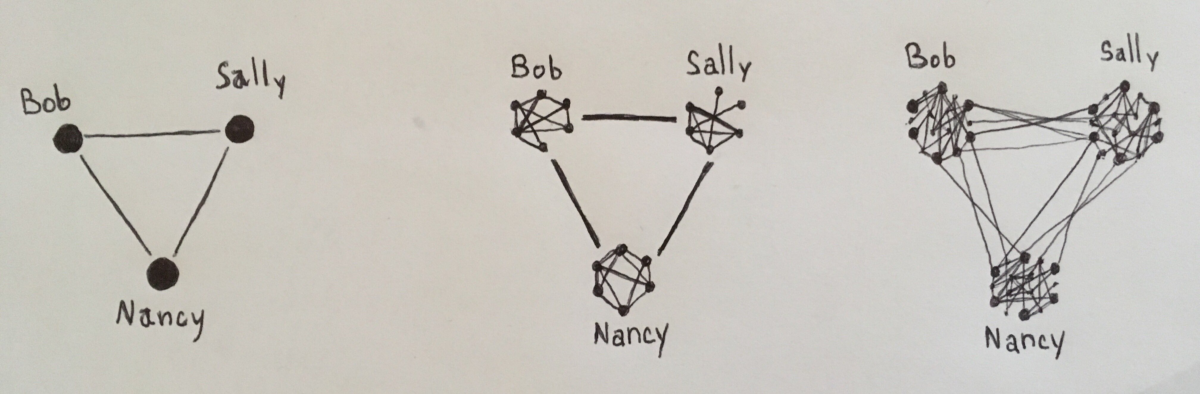
EDIT: I found this image on twitter via Richard Bartlett, originally from this post on going beyond consent and autonomy, and it’s a good way of illustrating some of what I’m getting at here. The version that this post is about would have not just lines between the people but circles around some subsets of the dots, across people.

Constantly consciously expanding the boundaries of thoughtspace and actionspace. Creator of Intend, a system for improvisationally & creatively staying in touch with what's most important to you, and taking action towards it.
Have your say!