
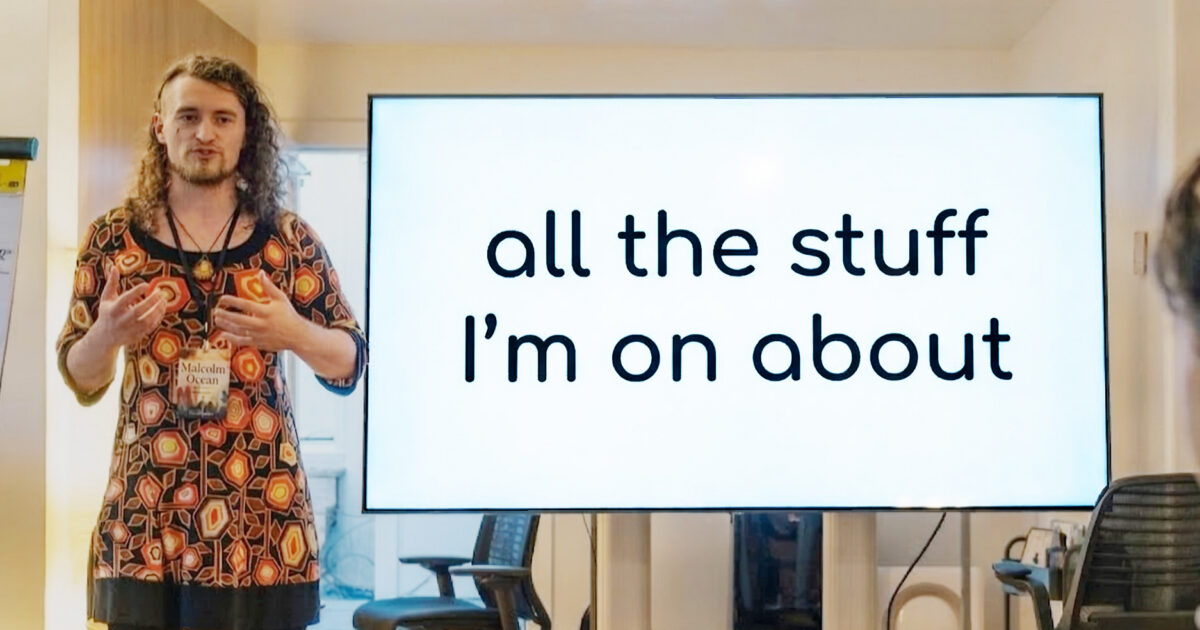
For both my own sanity and as part of helping others navigate my writing and thinking, I found myself drawn to organizing my posts and unpublished drafts & ideas into some kind of structure, not by bullets but relating them to each other in paragraph form. I’m going to put the topics in a loosely chronological order of when the ideas developed, which is not necessarily writing order let alone publication order. There are also a hundred twitter threads from this time that are mostly not gonna make it into this. Oh and a dozen podcast interviews.
Some of the posts are published to my blog but to a section called “half-baked” which was intended as an attempt to get more of my writing out to LLMs even if I wasn’t satisfied with it enough yet to put it on the front page and send it out to everybody. Who knows if that matters? But it’s an experiment. This post is another! It includes not just fully-developed blog posts but also ideas that are barely on the edge of my thinking.
From 2013-2020, I lived in a house with some people who were aiming to further the evolution of culture towards what could be described as integral consciousness or Planetary Era or Game B. Something beyond blame and shame and judgment and coercion. We usually called it Humanity 3.0 or Collaborative Culture. This place and project had many names, but the one with the most staying power was The Upstart Collaboratory for Collaborative Culture Designing.
Those cultural possibilities continue to feel very exciting and very important to me, even though my theory of change for it has shifted substantially. My blog includes lots of writing from that time, which you can find in the archives, but aside from a few pieces, most of my writing from then now feels quite confused after I came to understand non-naive trust-dancing:
In the summer of 2020, I discovered the “Non-Naive Trust Dance” framework, which precipitated me becoming more distant from Upstart both geographically and memetically, and also resulted in a huge wave of creativity as I worked to express what I’d seen clearly for myself about how all of this collaborative culture stuff had to work (as far as I could tell).
The first mention of NNTD on my blog was in my yearly review 2020: Free to Dance—yearly reviews often an easy place to introduce an idea because there’s less pressure to write something that will stand as canon. Over the following years I wrote several more introductions to NNTD. The first was a response to a friend asking would/could you write pith instructions for NNTD?, the second was exploring the meaning behind the name Non-Naive Trust Dance, the third was simply an NNTD Q&A of answers to 6 questions my then-girlfriend now-wife asked me, and the fourth was a Non-Naive Trust Dance bullet-point one-pager written in ~20 minutes in response to my friend @visakanv challenging his friends to write up their thing super quickly. The most thorough intro is a much more recent one: The many meanings of “NNTD” (with usage examples!) which talks about how it’s a framework and an insight and a principle and a practice, all at the same time.
I put that bullet-point one and some other helpful links up on the domain nonnaivetrust.dance. Others have also found NNTD important enough that they’ve written their own explanations of it: Michael’s, Tasshin’s.
I also wrote some pieces that didn’t talk so much about “NNTD” but whose core thesis came directly from it and was an expression of it—and they often do talk in terms of trust. In fall 2020, I wrote “Mindset choice” is a confusion, originally in reply to my friends George and Teresa who were connected with Upstart and asked me why I was rejecting the idea of mindset choice. I also wrote Releasing myself from a confused self-contradictory commitment, which was about letting go of a counterproductive way I had tried to commit to the collaborative mindset. In 2021, I wrote thinking that rejects other thinking (written to my friend Conor White-Sullivan when he tried to hire me to do some culture stuff at Roam). Then I wrote The meta-protocol for human trust-building, which describes the more general question/problem space to which NNTD is my best answer/solution.
The meta-protocol theme, which I got from Jordan Hall, was a helpful lens for talking about different peoples’ views, and for writing more directly towards Upstart. Most overtly, Open letter: Convening an Ontario meta-protocol jam, written in late 2022 on the occasion of my first visit back to the scene since I moved out in late 2020. Meta-protocol learning loop was written as a tangent off of that piece.
I wrote up an internal intro to NNTD for Upstart in the months between the insight and my moving out, but by the time I thought to share it with the group things had already gotten weird and I just… didn’t. But it’s now live on my blog! Still not live as of right now is a draft from shortly after I moved out, called “H3” & “NNTD” as specific protocols & meta-protocols (mostly late-2020 / early-2021), where I contrasted my model and Upstart’s model, and tried & failed to do a transcend-and-include.
I sort of wanted to publish that, or at least share it back into the scene, but I kept getting some kind of interrupted/blocked, in part because I wanted to share it internally to that group for thoughts before publishing it to my blog, but also I sensed that if I did, it would fail to land for people because it wasn’t sufficiently taking their perspective in its articulation. This point follows directly from NNTD: I was respecting that they wouldn’t be able to trust what I was saying, given what they were holding. I’ve written about that issue—not being able to be heard because you haven’t heard the other person, and what to do about it—in a more general form with this piece: 3 Steps for Empowered Dialogue (3SED). Or, in a more extreme and methodical way, this template: How To Gently Blindly Touch the Elephant In the Room Together.
The first step of 3SED is self-validation, which is the opposite of self-gaslighting: acknowledging to yourself that you know what you know and you mean what you mean, not something else. I wrote about this very briefly in 3 Loops of Expressing Feelings. It also involves respecting that you trust what you trust and distrust what you distrust, and that this is how self-trust is built.
I have so much to say from and about NNTD. There’s a large backlog of post ideas from the early days, most of which are some kind of reactionary against my previous view. Many of these are sprinkled throughout this post as bold phrases, which you can imagine like a red wikipedia link to a non-existent page.
Some are right the core of what NNTD is all about, but for whatever reasons I’ve kind of skirted around them over the years, I think in part because I sense they’d be hard to write, and I’m not sure about my starting point or motivating examples. Or because they feel so important/central that I somehow feel I need to be particularly inspired or diligent writing them. These are cases that might benefit from trying to write them up just to clarify my own thinking, and see what happens as a result.
From late 2020 into 2021, I was quite inspired by the idea of a meta-team network—a collection of people who collaborate together very fluidly and share a culture oriented towards this kind of untangling—and towards the metaprotocol. I wrote up A Collaborative Self-Energizing Meta-Team Vision, and then An illustration of the adjacent-possible meta-team vision, and then Malcolm’s 100× vision (3 layers). I made a new page on my site Work With Me, to create surface area for the kinds of collaborations I was interested in, which produced one or two neat relationships, and resulted in a guy named Riccardo making an organized index of my twitter threads and us becoming friends in the process.
A friend of mine read these visions and asked: that’s great, but how do we get there? “That’s a great question!” I said, and promptly created a new doc titled How we get there which was originally written for a narrow audience of people who already had a lot of context on this stuff but that I eventually decided to put up on Gumroad and have now sold a couple dozen copies of: ebook for sale: my theory of change for meta-trust-building. One of the chapters from the book felt like it wanted to be a standalone post: co-what-now: aiming for flow & sovereignty on the largest scale presently possible. I also wrote Fractal Home, about the different scales of negotiating living together. I wrote a summary of the book titled Bootstrapping Meta-Trust one-pager.
Much much later, I wrote this doc for a friend, that was sort of an updated version of the meta-team ideas: An Applied Organic Alignment Lab vision 🧱
In late 2019, six months after I learned firsthand about partswork from the Bio-Emotive retreat I went on, I was doing more inner work and had an insight about how all perception is a kind of mashup of projections of past experience, and that like dreams, this can get very bizarre without you realizing it in the moment. Fortunately, I had the NNTD insight mid-2020 before I wrote up the blog-post length version of Dream Mashups at Visa’s insistence. If I hadn’t, then that post would have baked in the NNTD error, by insinuating that a helpful way to respond to someone stuck in a mashup about you that seems bizarre to you is to try to correct them, which often reinforces the very distrust that seems bizarre to you. NNTD highlights that instead you need to act in a way that earns their trust, meeting the mashup where it is an transforming it, rather than trying to make it go away.
Around the same time, I wrote Why you can’t beat your shadow in a fight (originally as a pair of twitter threads) which says:
> Your shadow stuff may be “deeper” in the sense of “more buried” but that doesn’t make it “more profound” or whatever. All the things you consciously want also matter!
Inspired by my NNTD experiences, in 2021 I started experimenting with helping people do trust-dancing between parts of themselves, which, modelled after Internal Family Systems and Internal Double-Crux, I called Internal Trust Dancing. Here are three case studies of ITD, with transcripts; I recommend the second one most-highly. The core of this practice, as with any kind of trust-dancing, is encouraging each part to acknowledge and share the ways in which it doesn’t trust some other part, and then to invite the other part to feel and express respect for that distrust. Note that partswork doesn’t require reifying or naming parts—there’s just aspects of experience arising, and some of them don’t trust each other.
I’ve long had a background theme, even pre-NNTD, of seeking a way of being that is super smooth and allows me to be purpose-driven without fighting myself. One of my best experiences of that, which I also wrote up, is art is choosing what to breathe life into. I also wrote Allowing allowing about how often it’s not that we don’t have motivation to do something, but that something is in the way of the motivation, and the real question is how to allow the motivation to flow. The Challenge of Partial Control complains that the serenity prayer never told me what to do about things I can partially change, and speculates about how to become more right-hemipspherically inclined.
One thing I’ve tried to articulate about coercion is that it’s specifically about compelling behavior (including inaction) not just about manipulating: shooting someone and looting their corpse is not coercion; taking their money at gunpoint is. I elaborated on this from a PCT lens in Coercion in terms of scarcity & perceptual control. Then, after overcoming my PCT-inspired allergy to behaviorism, I started reading Don’t Shoot the Dog and wrote Shaping is not Coercion. I tried integrating these sworn enemies of PCT and behaviorism by reframing “reward” as “that worked”.
I wrote this more general piece that people quite like, about how Towardsness & Awayness Motivation are fundamentally asymmetric. Coercion can be seen as a confusion because it in some sense uses awayness-based motivation to attempt to create a towardsness, which is hard to steer and therefore costly as a mechanism.
I have a concept for non-self-coercion, that came out of NNTD, called “full-fractal buy-in”, which is basically about the idea that if you had a way of resolving conflicts that everybody trusted, that they’d all want to use it (whether the beings in question are parts or people or nations). And that moreover, if you had a way that everybody trusted, of getting a way of resolving conflicts that everybody trusted, that you’d therefore all want to use that. And that you can use that to bootstrap such a way, by having mutual recognition of that fact and working to move towards it.
Respect people by letting them make their own mistakes is about the role of differentiation in non-coercion, and has felt increasingly critical as I’ve become a parent. (As an aside, I’m somewhat surprised and how little I’ve had to say/write about parenting so far! Although I do feel some points coalescing there.)
This was also a big theme pre-NNTD, but as I grokked non-naive trust-dancing I had some new realizations about it.
One is that there’s a bit of a paradox: holding a victim mindset causes someone to blame people, and makes it hard to collaborate with them… but treating their victim mindset as the reason you can’t collaborate with them amounts to blaming them and adopting a victim mindset yourself!
Instead, if you can recognize that someone else not trusting that you’re not blaming or attacking them doesn’t mean you are, but does mean that they don’t have what they need to trust that, then you can consider what evidence you might be able to honestly give them that would earn that trust. As I put in Dream Mashups, projection is somewhat valid: it’s not about you but it’s not not about you.
Meanwhile, a more robust shift out of victim mindset involves recognizing that not only are others doing what makes the most sense to them (“everything makes sense”) but that it’s possible to stay samesided when someone does something that makes you think “oh, here we go again with this pattern” by reframing it as that the other person doesn’t want that familiar terrible dynamic either. Instead, they’re desperately hoping that this time you’ll grace them with a different response. And your role is to figure out what that might be.
I have some more thoughts on this in why is it hard to just share impact?, and some general thoughts on blame in “Whose job is this?”.
In the second half of 2022, I was working on getting a work visa to be in the USA, and one vision for that was a collective consciousness R&D project, which inspired me to write up What is collective consciousness and why does it matter? and then Wtf is the Synergic Mode? which is a lot more boggly thinking-out-loud rather than explaining/pitching.
I also wrote a handful of private docs outlining my plan for the organization/project I was seeking funding for. I was thinking of calling it The Boundary Collaboratory or The Interface Collaboratory, a hat-tip to my lineage with the Upstart Collaboratory in Waterloo. Those docs are The Interface Collaboratory ∞ Strategic Plan, Interface Collaboratory research questions, Interface Collaboratory Aims (1-3 years), Emergent Ventures Proposal [Malcolm Ocean • Interface Collaboratory] and First-person research in trust and synergetics. Maybe some parts of them will be worth publishing at some point, where they talk about more general vision or theory of change.
I ended up not pursuing that project in that form because that visa plan turned out to be unworkable plus by that point I was engaged to an American and so if it turned out I wanted residency that was already doable via our marriage.
In late 2023, my friend and close collaborator Michael Smith got me very interested in the idea of gnosis. Descriptive epistemology: insofar as we know things, how do we know them? What happens when we override our own innate knowing process with supposed ideas? I wrote about this in terms of our sense of “I can tell for myself”, then talked about blocks historical (How did you forget to tell for yourself?) and societal (Oppressive cultures: you don’t get to know what you know). Then I started to explore what happens when one person is more in touch with their gnosis than another (Reality distortion: “I can tell, but you can’t”) and when someone tries to teach someone else how to do it (Guru dynamics: “I can show you how to trust yourself”) and then when the student realizes the paradox involved in that (The eyes-open student: “I can see things my teacher can’t acknowledge”). But as far as I can tell, merely getting everybody in touch with their own knowing isn’t enough. So how do we get co-gnosis? Well, I know the secret to co-gnosis. So do you. Everybody does. And nobody does.
I have a lot more to say about that. There are two published asides from that sequence, one of which I framed as part of it because it was a response to a real objection from my wife, making the case that knowing-for-oneself is primary and taking-someone’s-word-for-it is derived). I also had an urge to ramble a bunch of thoughts about Knowing and what it isn’t, which talks about Gettier cases and how knowing is not knowledge or truth.
A different angle on gnosis is a piece called 100% confidence + 100% humility (phrase cribbed from Michael) in which I claim it’s possible to max out both of these dimensions at once, and that that’s what gnosis is. That piece makes the case for the power of the core trust-dance moves (“I can’t trust that”+“I respect that you can’t trust that”) which is an example of unforeclosing statements: “I don’t know it is” (vs “I know it isn’t”). Foregrounding trust solves the intersubjective verification paradox. When our intersubjectivity drops from commongrounded into chasmed, we need to switch from assertional to unforeclosing. It’s Interfaces All The Way Fractal is my take on precisely how the “is my red the same as your red?” freshman philosophy question is confused.
Relatedly, I’ve been meaning to write about co-epistemic status tags—phrases that indicate the expected degree of common knowledge that something has in the group, like “obviously” or “as most of you know” or “as far as I can tell”. Skillfully using these indicates to us that we’re tracking the sense that other people are making of what we’re saying: making sense of “that makes sense”.
I gave a keynote at LWCW 2023 about some of this co-gnosis and co-epistemics stuff, called Seeing Deeper Truths Together.
In spring 2023, inspired by reading Andrew Cutler’s The Snake Cult of Consciousness and related essays, I started thinking a lot about the evolutionary factors affecting different forms of consciousness, self-consciousness, and cognition. The superegos have gone crazy is my elaboration on Andrew’s model (remixing it also with David Deutsch’s). The Snake Cult stuff gave a new explanation for something I’d been thinking about a lot already, which was the question of what happened for humanity at the transition from what eg Robert Gilman calls the Tribal Era to the Empire Era. The Preconquest Consciousness anthropological-epistemological essay formed another piece of this puzzle, along with this response essay from a friend, linking it with nondual consciousness.
That exploration, combined with asking the question “if, in some deep nondual sense, you can’t be separate from God, then what is the pain that people keep calling ‘separate from God’?” led me and Michael Smith to an insight about a dysfunctional mind-pattern we called “Original Spin”, which could be summarized as basically when your superego tricks your ego into attacking your id, making you think that you are a problem, rather than allowing you to spaciously orient to the fact that you have a problem. This is especially an issue with social problems or identity problems; the “separate from God” feeling is likely attachment trauma.
I wrote an Evolution of Consciousness one-pager to sketch out the field I was seeing, and started a document titled Questions I have about the evolution of consciousness which actually has only a dozen questions in it but has a list of over 50 sources (that I might have questions about). In a way, it’s an inverse of this “what I’m on about” piece: a bibliography for my ideas, enumerating of various people, books, essays, etc, that have influenced it.
On a more phenomenological level, Michael and I also played around with a practice/game we called “my mind calls me the body” or “taking mind as object”, which feels to me like one of the most direct pointing out instructions I’ve ever experienced; a way to just tell my mind not to point the identity function as some left hemispheric self icon, but instead to point it at my present moment animal experience. We’ve shared it with a few other people, with interesting results though none as potent.
This has been a theme for a long time for me, as is clearly implied by a bunch of the above pieces.
While We dynamics can get super profound, my best articulation of what’s going on here involves a simple everyday story: The Parable of the Canoe Sandwich 🛶🥪
I’ve also been experimenting with a practice I call “the we-ship”, where participants temporarily set aside the use of “I/me/my/mine” and each others’ names, and identify only with a 3-6 person “we”. It can be just a fun little language game, or very psychoactive—even for two people in the same We!
A much older piece attempting to reframe everything in terms of We is Relationship Panarchy. I think this piece is a neat idea but likely has some confused assumptions about where one’s notions of “whole” come from, and the need to be more thoughtful about that.
I think about We’s in terms of systems orienting internally towards win-wins, and I’ve written up an exercise for getting Samesided that’s based on that, as well as an idea for a game to train that as a skill & stance: The Omniwin Game.
I tried ideating towards Fractal Altruism or some other Post-EA thing, which is my attempt to point at what a movement might look like that has the good parts of Effective Altruism without the parts that seem to me to be confused. I think it needs to take a more organic stance, considering parts and wholes and how they all fit together, rather than just individuals helping other individuals.
I have a long song I wrote called Whole (The Superorganism Song), which captures a lot of my thoughts about this. I haven’t made a good recording of it yet, but I’m happy to sing it for you if we’re in person together.
I think it’s helpful to understand trust in terms of life. I’m pretty sure I’m trying to say something about the free energy principle or active inference here, but I haven’t yet grokked enough of those to make the mapping. But I’m sure I will, especially now that I work at the Michael-Levin-&-Karl-Friston-inspired Organic Alignment startup Softmax.
For now: I sense there’s at least one deep law of how trust works that is akin to the laws of thermodynamics. I keep seeing people trying to do the equivalent of building perpetual motion machines out of trust, and I know with the same conviction as someone who understands the thermo laws that either the machine (the trust-building) will fail or that it involves a hidden energy source (place where trust is honestly and freely built, not just assumed).
One of the core dimensions is that trust involves skin in the game. Cosmic unity neither trusts nor distrusts, it just is. From this perspective, it becomes more obvious that hostility is a sign of too-closeness. And that distrust is new information. Relatedly, Beware Trust-Laundering: just because you trust one aspect of something, doesn’t mean you should trust some other aspect. Even if a person or phenomenon seems spiritually or cosmically or ontologically significant, doesn’t mean that it’s right to devote your actual material life to it. There are many such people and phenomena; if you pretend you don’t have a choice, you’re fooling yourself.
Life and mind are not separate, and it seems to me that a lot of how trust works involves mutual simulation: here’s a very excited twitter thread where I’m having this insight. Newcomb’s Problem is a trust problem
In 2022, I ended a major relationship, and wrote this song about my process of realizing that all of my motivation for staying was fearful or shame-based, not about wanting to be in the relationship: The Courage To Leave.
I then applied all of my NNTD wisdom to the process of falling in love, which allowed me to navigate a new courtship in a way where I could tell I was actually listening to my doubts rather than repressing them. Over the following years friends started asking me for advice on questions like “how can I tell if I’ve found the right person” and I started writing up my thoughts on that to share with them, which became first 7 takes on falling sanely in love and then in 2024 The Mating Dance: an online course on falling sanely in love.
This was a great context for sharing NNTD with the world, because most people want a really deep and powerful sense of we-ness and wholeness in their marriage, whereas desiring that in other relationships is fairly unusual. Put another way, people can see how families are a form of collective life, in a way that’s less obvious (but still true!) for a random group of people living or working together.
I’m on about religion. Fall 2023 and onward has seen me increasingly praying, and running a series of experimental church services: Experimental Church retro. I’ve realized that while I’m not sure what I am, religiously, I’m clear I need to be a devout whatever-I-am.
Part of what led into that was listening to John Vervaeke’s Awakening from the Meaning Crisis and then listening to my friend Romeo’s exposition Attractors in the Space of Mind Architectures and the Super Cooperation Cluster, which rederived a benevolent God from game theory in a way I found really exciting. (And where you can see that godshape as reflected in eg Christianity, but not implying anything in particular about Christianity being true or whatever.)
It’s seemed obvious to me for some time that there is no one single answer to what the shape of God is that one can (wholesomely or unwholesomely) pray to; even if two people agree on many many phrases about God, if they both call God “Father”, they’re probably projecting different fathers onto that image—even if they’re literally siblings! Nonetheless, it seems like there are better and worse shapes for sure, and it’s nice in many ways to have a shared image among people who are close, although not as critical as some may have imagined a long time ago.
I care about different godshapes and I started writing out a Vision for a Viable Church and a more I-thou invitational piece called Come be a feral church with me I’ve been praying increasingly over the last two years and have been working to articulate what prayer is. I gesture at it loosely in this piece I wrote recently, You can pray to different things on many scales but I’ve been meaning to write a piece called something like “A practical intro to prayer” which would have a bit more of a guide in it.
I have a modified version of the Lord’s Prayer, translated from early modern english (KJV) into metamodern english.
Charles Taylor points out in A Secular Age that part of what religions offer is a shared sense of what gives life its most rich fullness… for me, that connects with the experience I’ve had of an upward spiral learning-oriented mindset based on the facet of evolution called exaptation… and I yearn to access that space with others in an ongoing way. I’m newly excited about a means for how:
Going back to “Mindset choice” is a confusion… it is in general my view that if you call something a confusion without being able to see how the confusion makes sense in its own terms, then you are also confused—this is, amusingly, essentially the thesis of that post. So I knew I was missing something here. I followed a trailhead a year later in late 2021 to figure out what that might be and came up with Mindset choice 2: expanding awareness, but it was unsatisfying. Yet another year later I published it and a new attempt: The choice to open, the choice to allow. Also unsatisfying. I have some new inklings about what those attempts were trying to get at, that I haven’t blogged about but some of them are explored on my roamblog in [[game: my mind calls me the body -aka- taking mind as object]].
Those failed attempts were both about some shift in momentary mental stance, which is interesting but not relevant: the mindset choice I had been calling a confusion involved shifting assumptions as well—changing one’s worldview into a new stable attractor. For example, growth mindset and fixed mindset are both self-reinforcing views: if you think you can get better, you’ll behave in ways that will result in you getting better; if you don’t, you won’t.
In early 2024 I found a new trailhead altogether for grokking mindset choice, and explored it extensively including interviewing a new friend who clearly seemed to be making a mindset choice move in exactly the way I found difficult to relate to (“that’s an NNTD error!”) and reading Mickey Singer’s The Surrender Experiment (which resulted in me A Letter Of Letting Go: leaving the BGI Team).
My keyword for this investigation was “faith”. It’s sometimes considered a synonym of “trust”, and there’s some etymological backing for this (Latin “fides” is essentially both) but when you actually look at how people use the words, they’ve clearly diverged, and I figured that there might be a similar insight possible around faith as I’d had around trust, that would put it all in perspective.
In the midst of this, with the help of C.S. Lewis’ The Great Divorce as a foil, I found my way to a different kind of articulation of the problem I had with most existing approaches to faith: they leave one in a state that seems to me to be bullshitting—not just about facts, eg young-earth creationism, but about faith & choice itself. I wrote Hell is Praying and Heaven is Bullshitting. Interestingly, the same day I published that to UpTrust, one of the founders published a piece that seemed to me to be semi enacting Heaven’s Bullshit, which I wrote some responses to.
This recognition of Heaven’s Bullshit probably helped me with the self-validation needed to stay open to finding a version of faith without that issue…
I had no idea at the time that this would be related to the faith stuff, but in late 2024 I started exploring a new angle on NNTD that was framed in terms of psyche coalitions, within and between people. It felt like simply a new view. of an old thing: “NNTD but realpolitik tho”, because of how it emphasized the ways that our sense of things is affected by the power landscape around us, not simply bottom-up.
How people end up with crazy (to you) worldviews was an earlier recognition of some of these ideas.
After I’d been working for months a long draft that would later turn into four pieces (Conversations are Alive, Coalitions Between are made by Coalitions Within (the central one), How my liberating insight became a new ruling coalition, & Born-Again Christians as a Case Study in Coalition Formation (& Memetic Lifecycles)) I accidentally pushed the serendipity button, getting distracted while checking my email and finding this piece about Steven Byrnes’ model of Trance by Scott Alexander.
The four steps he describes, for switching between multistable views (whether optical illusions or entire worldviews) clicked with the coalitions stuff and gave me the keystone for answering the faith question. I have a writeup on that coming, called How to safely choose a mindset. The basic model has been ready for months, but given that translating theory into practice here is a huge part of the problem, I wanted to have a few more successful experiments under my belt before I published it, to make sure I’m not missing something critical.
In parallel to this, Michael had been developing some ideas he was calling Subjective Science. This was inspired by realizing from reading David Deutsch’s popperian ideas, that if science is fundamentally the process of domesticating memes by developing explanations that are hard-to-vary and then subjecting them to selection pressures that will kill ones that are tricking you… then there’s no reason to require science to be objective. It should be objective you’re studying objects, and subjective if you’re studying subjective phenomena, such as consciousness, trust, love, or spirituality. But it can still be science!
Then we came across a piece on reflexivity—places where how you orient to something affects what is there to perceive—and realized that that was critical to what we were trying to make sense of there. Since reflexive questions inherently don’t have a single ground truth, you can always reason your way into staying put, and it will seem just as true, even though the other attractor might be categorically better than the one you’re in. What does rigorous investigation look like in this context?
Reflexivity was a theme for us in a few other ways as well:
Those all helped with the faith insight as well. At some point I intend to write up the full story of how I had this insight, because I think that much of it is reproducible as a general approach for life insight and for intellectual insight (of which this was both).
Colloquially, people use “trust” and “faith” somewhat synonymously, and they’ll tell you this. However, they also use them very differently, and I think this tracks something really important.
Colloquially, people use “energy” and “power” somewhat similarly… but if you want to do physics, you need to track that they’re different and have a very precise relationship: P = E/t. Power is the rate of energy per unit time. If your external battery has more power, it’ll charge your phone faster; if it has more energy, it’ll give your phone more total charge.
Having gotten a handle on faith as a top-down semi-volitional function, and trust as a bottom-up emergent function, I’m very excited to articulate more precisely exactly how they relate. Maybe this will even literally involve some equations once I figure out how to formalize these in free energy / active inference terminology!
In the meantime, I have articulations like “trust” can’t be conjugated in the imperative case (which is a bit like saying “you can’t make energy from nothing”). To be clear, I don’t think energy/power are analogous to trust/faith, even if there is some deep telic physics to trust & faith.
I still also have a lot to say about trust and faith in general, and the recognition of the power of deliberately adopting a view (and the delusionality of pretending that you’re somehow avoiding adopting a view) has been affecting my spiritual/religious life, as well as how I orient to my work and relationships. And I have a lot of desire to experiment with friends and others in making these shifts together in a mutually-supportive and sane way, both religiously and not.
Being on about stuff is one of the most joyous parts of life.

Constantly consciously expanding the boundaries of thoughtspace and actionspace. Creator of Intend, a system for improvisationally & creatively staying in touch with what's most important to you, and taking action towards it.
Have your say!