“If you can trust yourself when all men doubt you, but make allowance for their doubting too” —Rudyard Kipling
I’m intending to write a whole sequence of posts that express various elements of the Non-Naive Trust Dance framework I discovered last year, and thought that a good piece to write early on would be an introduction that talks about why it has the name it does, answering in brief these three questions:
I suppose it’s worth noting that I don’t remember choosing a name for this thing when I discovered it last year—this was just sort of the obvious thing to call it as I was seeing it from my perspective at the time.
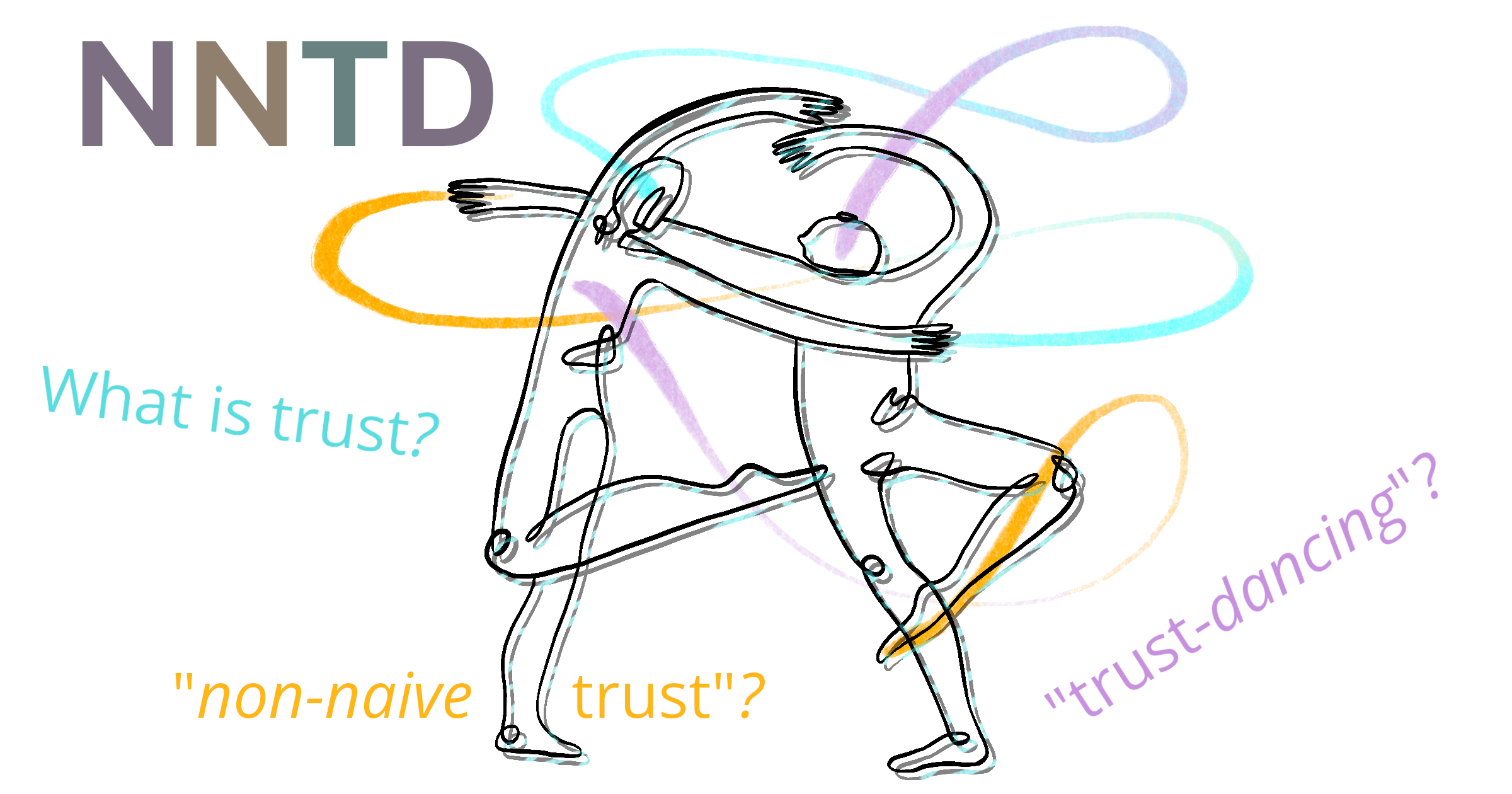
I’ll gesture at it a few ways. These are not distinct ideas, but many angles on the same underlying phenomenon:
Trust also needs to be qualified as trust in something in particular. There’s no general “I trust you” (or “I distrust you”). If someone says that, generally the particular-something is clear from context (“can I take the car?” “sure, I trust you”) or the speaker is confused. This paragraph illustrates how it isn’t just one thing:
“I trust Alice to return a $10 loan but not a $10,000 loan, Bob to return a $10,000 loan but not to babysit an infant, Carol to babysit but not with my house key, Dave with my house key but not my intimate secrets, and Ellen with my intimate secrets but not to return a $10 loan. I trust Frank if a friend vouches for him, a taxi driver as long as he’s displaying his license, and Gail as long as she hasn’t been drinking.”
From Bruce Schneier, Liars and Outliers — via Kaj Sotala, “Don’t trust people, trust their components“
If Alice wanted to borrow $10,000, or Bob offered to babysit, this person would then be faced with a situation where their friend would be making a bid to be trusted in a way that the person actually doesn’t trust them.
That’s a tough situation to be in, particularly if it doesn’t feel easy to talk about.
» read the rest of this entry »This post is adapted from notes to myself plus a bit of context I added for some friends I shared the notes with. It’s a cool example of how gradually making an unconscious pattern more conscious can lead to transformational insight, and the specific pattern also seems like one that’s likely to resonate for a lot of other people with similar experiences to mine. I’m willing to bet that other people who’ve interacted with me a lot directly are familiar with this pattern as it shows up in me—and I’d be interested to hear about that!
For the last week or so, my partner Sarah and I have been doing a lot of active noticing a particular tone I sometimes have, which Sarah hates, and she described it as being lectured. It took many months of work on both our parts for her to be able to articulate the feeling so clearly as “lectured” and for me to be able to acknowledge that there’s something there even though I wasn’t sure what or why. While I could tell it didn’t work (because it made Sarah defensive) I didn’t initially have any intrinsic motivation to speak any differently. More on that work and on motivation to change, below.
Anyway, since we’ve gotten a better handle on that, I’ve gotten a lot better at noticing when I’m doing the Lecturing thing, often via Sarah making a 🤨 face at me, but sometimes from my own stance or tone. As I’ve been integrating that unconscious drive, I’ve started often interrupting myself midsentence, something like “So you see, it’s really important… (S: 🤨) …that I lecture you about this. You need a lecture.”
And speaking that explicitly defuses a lot of the tension, which has already been great. Yesterday some additional integration happened, via gentle prompting from Sarah. She was saying something and I was suddenly experiencing an immense urge. I had enough mental space to hold that urge, and I strained to speak: “It. Is. So. Hard. For. Me. To. Not. Lecture. You. Right now.” I started to try to convey something about my experience of that to her, and she very gently and groundedly suggested “is there something you might want to do for yourself, first?”
I tuned into that part of me and it voiced internally “why are you so fucking stupid?!?“
» read the rest of this entry »In my 2019 yearly review: Divided Brain Reconciled by Meaningful Sobbing, I experimented for the first time in a while with setting a theme for the upcoming year: Free to Dance. And lo, while I didn’t think about it that often, it’s proved remarkably relevant, in ways I couldn’t have anticipated.
The original concept of the phrase came in part from having just picked up Bruce Tift’s book Already Free: Buddhism Meets Psychotherapy on the Path of Liberation, which by early January I could tell would be a major book of my year. Another related dimension of it was something I realized in doing some of the emotional processing work last year, which was that parts of me sometimes still kind of think I’m trapped at school where I’m supposed to sit still at my desk, among other indignities.
The other main piece was observing at a couple of points that I sometimes seem to move through the world as if I’m dancing, and other times much more heavily. During an exercise at the Bio-Emotive retreat midsummer, we were asked to reflect on a question something like “how would I be if I were showing up most brilliantly/beautifully?” And what arose for me is something like “I think I’d always be dancing.”
So all of these layers mean that the social isolation of the pandemic didn’t put much of a specific damper on this life theme, even though I was hardly free to go to dance events (except some lovely outdoor bring-your-own-partner contact improv events that a friend hosted). I had been intending to travel the world a bit, to San Francisco, perhaps Austin, perhaps the UK, and none of those visits happened.
What did happen?
» read the rest of this entry »This article was adapted from a late-night Captain’s Log entry of mine from last April. I did most of the edits at that time and thought I was about to publish it then, and… here we are. That delay is particularly amusing given the subject-matter of the post, and… that feels compatible somehow, not contradictory!
I’ve done a bit of writing since then, getting back in touch with my intrinsic motivation to blog without any external systems. We shall see when any of that ends up getting published going forward. I am publishing this now because:
One interesting evolution is that ppl prefer to see things unpolished rather than perfected
Perhaps because it’s more relatable
You squint + you can see yourself doing it
What caused this change?
This trend is only increasing, + may explain why we'll (maybe) record everything
— Erik Torenberg (@eriktorenberg) January 8, 2019
The writing begins:
@ 12:30am – okay, I need to account for something
I woke up knowing today was a blog beemergency. I went back to sleep for 1.5h.
I got up, knowing today was a blog beemergency. I did Complice stuff, almost-all of it non-urgent.
I reflected late afternoon (above) knowing today was a blog beemergency. I did other stuff.
…and I had the gall to consider, around 10pm, that I might weasel.
(If you’re not familiar with Beeminder, “blog beemergency” means that I owe Beeminder $ if I don’t publish a blog post that day. Weaseling in this case would refer to telling it I had when I hadn’t, then (in theory, and usually in practice for me) publishing something a day or two later to catch up)
I don’t want to get into self-judgment here, but just… no. Weaseling undermines everything. At that point you might as well just turn it off or something. Except, bizarrely… part of me also knows that this Beeminder blog system does continue to work relatively well, despite my having weaseled on it somewhat and my having derailed on it regularly.
…in many ways, the Beeminder part of it is actually totally broken, except inasmuch as its ragged skeleton provides a scaffold to hang my self-referential motivation on—ie the main role that it provides is a default day on which to publish a blog post (and by extension, a default day on which to write) and it acts as a more acute reminder of my desire to be actively blogging. But… it’s not in touch with any sense of deep purpose.
…I don’t have that much deep purpose that generates a need to blog regularly. And it’s nebulous the extent to which my sense of deep purpose is connected with needing to blog at all, at the moment.
I do have the sense of having relevant things to say, but I’m—hm. Part of it is like, the strategic landscape is so up-in-the-air. Like who is Upstart? What’s this Iteration Why thing, and where am I in relation to that? And how all of that relates to my other projects!
So then, I could be publishing other things that are more instrumentally convergent, independent of whatever exactly emerges there. When I look at my Semantic Development airtable though… a lot of this stuff actually feels like it would be pretty publishable, and I feel quite attracted to working on it… so what’s the issue? Why have I been doing so much Complice stuff, the last week, for instance?
It’s now been five years since I first attended a CFAR workshop. I wrote a 3-year retrospective 2 years ago. Today I want to reflect on one specific aspect of the workshop: the Againstness Training.
In addition to the 5 year mark, this is also timely because I just heard from the instructor, Val, that after lots of evolution in how it was taught, this class has finally been fully replaced, by one called Presence.
The Againstness Training was an activity designed to practice the skill of de-escalating your internal stress systems, in the face of something scary you’re attempting to do.
I had a friend record a video of my training exercise, which has proven to be a very fruitful decision, as I’ve been able to reflect on that video as part of getting more context for where I am now. Here’s the video. If you haven’t seen it, it’s worth watching! If you have, I recommend you nonetheless watch the first 2 minutes or so as context for what I’m going to say, below:
One of the biggest things I’ve learned over the past year is how to truly let go of regret.
(Psst: if you’ve got Spotify, hit play on this track before you keep reading. Or here’s a YouTube link. I’ll explain later.)
A few months ago, in September, I went to a tantra yoga workshop called the Fire & Nectar retreat. The event involved a fair bit of yoga and meditation, but what was most powerful for me were the teachings on non-dualism. A lot of it made deep, immediate sense to me, and there were also pieces that were met with a lot of resistance.
One of the most challenging things that our teacher Hareesh said was this:
If you had a chance for a do-over, would you choose for everything to go exactly the same?
If not, you have not yet surrendered.
He clarified that this wasn’t talking about a dualistic sort of surrender, more like surrendering to reality. I seem to recall he was quoting someone, but I can’t find a source in my notes or on the internet. At any rate, this was a thing that he said, and I immediately recognized it as containing a perspective that I didn’t understand. A perspective that I feared.
I recognized it as a perspective that I’d been in a battle with for several years.
I wrote a post last year on two different kinds of expectations: anticipations and entitlements. I realized sometime later that there is a third, very important kind of expectation. I’ve spent a lot of good time trying to find a good name for them but haven’t, so I’m just calling them “the third kind of expectation”. On reflection, while this is unwieldy, it is an absolutely fantastic name by the sparkly pink purple ball thing criterion.
First, a recap on the other two kinds of expectations in my model: anticipations and entitlements. An anticipation is an expectation in the predictive sense: what you think will happen, whether implicitly or explicitly. An entitlement is what you think should happen, whether implicitly or explicitly. If your anticipation is broken, you feel surprised or confused. If your entitlement is broken, you feel indignant or outraged.
I made the claim in my previous article that entitlements are in general problematic, both because they create interpersonal problems and because they’re a kind of rationalization.
Since then, some people have pointed out to me that there’s an important role that entitlements play. Or more precisely, situations where an angry response may make sense. What if someone breaks a promise? Or oversteps a boundary? It’s widely believed that an experience of passionate intensity like anger is an appropriate response to having one’s boundaries violated.
I continue to think entitlements aren’t helpful, and that what you’re mostly looking for in these situations are more shaped like this third kind of expectation.
Lots of more abstract writing in the works, but in the meantime, an update on my personal learning process: I’m currently working on shifting out of a meta-oscillation between being intensely purpose-driven but stressed & tense and being self-compassionate & internally aligned but aimless & disoriented.
Of course, an update on my personal learning process is still going to include some abstractions!
I sketched out a 2×2 to capture these dimensions. I’m not totally satisfied with the axes or the quadrants, but the overall structure feels clear and powerful, and I’ll refine it over time. I’m trying to get more comfortable putting out drafts of things:
Been hanging out with @vgr, now my whiteboards are all like pic.twitter.com/cWaqqlRHPn
— Malcolm🌊Ocean (@Malcolm_Ocean) June 23, 2017
The ideal state is the one in the top right, » read the rest of this entry »
The process “giving feedback” is outdated. Or limited, at least.
Let’s do a post-mortem on a post-mortem, to find out why…
My friend Benjamin (who works with me on both Complice and the Upstart Collaboratory culture project) and I had an experience where we were making some nachos together, and… long story short: most of them burnt. We then spent a bit of time debriefing what had happened. What was the chain of events that led to the nachos burning? What had we each experienced? What did we notice?
This yielded a bunch of interesting and valuable observations. One thing that it did not yield was any plans or commitments for how we would do it differently in the future. Anything like “So when [this] happens next time, I’ll do [that], and that will act as a kind of preventative measure.”
Given that lack of future plans or commitments, one might ask: was it a waste of time? Did we not really learn anything? Will things just happen the same way again? » read the rest of this entry »
I realized recently that while I’m pretty consistently operating out of Growth Mindset, there’s another mindset shift that I’m often missing.
I was reading an insightful book called Influencer. One of the sections of the book describes a man with a love of chocolate, who wants to lose weight and tries to replace his chocolate-snacking habit with a carrot-snacking habit. I know the feel—chocolate is very compelling to me. From that book:
“Initially, failure signals the need for greater effort or persistence. Sometimes failure signals the need to change strategies or tactics. But failure should rarely signal that we’ll never be able to succeed and drive us to pray for serenity. For instance, you find yourself staring at a half-eaten ice cream cone in your hand. Should you conclude that you’re unable to stick with your eating plan so you might as well give up? Or should you conclude that since it’s hard to resist when you walk past the ice cream parlor on your way home from work, you should change your route? The first conclusion serves as discouraging brake on performance, whereas the second provides a corrective guide that helps refine your strategy.
The book describes the first response—concluding you can’t do it and giving up—as Fixed Mindset, and the second as Growth Mindset. They depict an overdramatic Fixed Mindset internal monologue:
“Henry wonders if he can overcome the genetic hand that he’s been dealt… has [no] self-discipline… surely he’s doomed… believes he hadn’t been born with ‘the right stuff.'” …etc.
I basically never have thoughts like that.
Which led me into the puzzle of why, if I’m consistently operating out of Growth Mindset, do I not consistently respond in that second way? That is, using each failure as a corrective guide, tweaking my path so I don’t encounter future temptations. » read the rest of this entry »