When I had my Non-Naive Trust Insight in mid-2020, I initially conceived of it as a patch on what we were doing at the cultural incubator I’d been living in for years, and I drafted this intro in Roam intended to convey it to the people I was living with. Things got pretty weird and I didn’t quite get it to the point of finishing it to share it with them at the time (although it wasn’t private—technically they could have looked, since it was in our shared Roam). So we’ll never know how it would have landed at that time. Some of the terminology or assumptions referenced below may be opaque to readers outside of that context. I’ve tried to add a bit of context but feel free to comment asking for more clarity.
“The impediment to action advances action. What stands in the way becomes the way.” – Marcus Aurelius
“If you can trust yourself when all men doubt you, but make allowance for their doubting too.” – Rudyard Kipling
Malcolm’s initial introduction to the Non-Naive Trust Dance, mostly written early October 2020
The [[[[non-naive trust]] dance]] is a framework created by [[Malcolm]] for modeling how [[non-naive trust]] is developed within and between people, which of course includes the nurturing of self-trust within each individual.
This post is a case study of the phenomenon described in Coalitions Between are made by Coalitions Within. If you haven’t read that post, this post may seem vague, but I’m talking about a very precise phenomenon. Having said that, if you like to start with concrete examples before moving to abstractions, you may enjoy starting here instead!
While working on that piece of writing, I had a fascinating conversation with a Born-Again Christian guy preaching with a megaphone at a Sunday fair. While my wife went to get the car, I approached him to find out what his deal was.

Fun fact about me: I’ve long found it helpful to talk to street preachers once a year or so, as a gauge on my ability to stay relaxed and grounded and open-minded while talking with someone who is trying to persuade and argue with me. This guy in particular was very aggressive compared to eg the chill Jehovah’s witness in Alamo Square last year… both in his use of the megaphone and in his loud declarations that everybody was sinners and needed to repent.
I opened with a simple question: “What does ‘repent’ mean?” He talked about it as a turning, a change of heart—and clarified that of course he meant the specific change of heart of accepting Jesus. Implied but not stated was that this also would include accepting and following the moral interpretations of the Bible that his particular church adheres to.
Rather than endure the tedium of him trying to convince me to change in some particular unlikely way, I figured I’d make much more headway in mutual understanding by asking him about his story of repentance.
He described his pre-conversion life as “living sinfully” — naming things like alcoholism, gambling, lying — a collection of self-destructive behaviors. And he felt totally out of control, and out of nowhere tried praying for relief, and suddenly had a breakthrough where by the Grace of God he became a righteous man (and joined some nearby available church).
It seems to me that essentially enough parts of him recognized that this shift would be a net win, compared to his existing self-destructiveness, that a new inner coalition was able to form and rule his psyche—with the support of this church etc. Which is not to say that all of his subsystems are happy with the new situation, but it’s at least a stable struggle, not a total race to the bottom. Christianity, classically centers around a struggle with temptation—found extensively in the writings of both Paul and Augustine, whose conversion stories could also make very interesting case studies for fractal coalition theory, and may yet.
I asked how it reached him, where his sense of conviction came from. He said he grew up hearing about the gospel—people came door to door to their house. I asked why he went with street preaching, because it seems like maybe the door-to-door thing would work better. He said they’d tried a lot of different things. I’m not sure how they were measuring their success but on that level it sounded kind of empirical.
I asked him about his theory of change: given the intention to convert people, why did he think the best approach was to yell loudly to people who seemed uninterested?
» read the rest of this entry »On the previous episodes of Fractal Coalitions Theory…
In the second post, I tell the story of a group of people attempting to create a kind of all-welcoming evolving meta-coalition, but which was systematically unable to welcome certain perspectives, and instead seemed to incentivize me to repress those. In this post I’m going to talk about what happened when I noticed this was happening, and how that played out over the following years.
(This post may not make much sense without the previous one; the first one is less critical.)
Up until my “Non-Naive Trust Dance” insight in 2020, I had oscillated between two broad coalitions:
This structure maps loosely onto what The Guru Papers calls “goodself” and “badself”. This is ironic because part of the whole aim of the culture was be post-dualistic, not talking in terms of good or bad, but it turns out that if you try to get rid of certain ideas on a conceptual level, you don’t necessarily get rid of the underlying dynamics of social power and perspective.
(Of course, there were other moments when if you asked why I was doing what I was doing, the answer would have been orthogonal to this: eg “I’m trying to win this ultimate frisbee game” or “I’m figuring out whether today is a good day to get groceries” or “I’m trying to grow my business”. Although sometimes even in such cases there would have been some sense of “and I’m doing this collaboratively (or not)”.)
And in spring of 2020 I realized that I was going kind of crazy oscillating between these two views, and desperately prayed for some sort of way to hold them both at the same time. And, after a few months of grappling with my confusion, I was graced with an insight that I’ve come to refer to as my “NNTD insight” (NNTD stands for “non-naive trust dance”).
The NNTD insight in large part consisted of:
» read the rest of this entry »I would like to give a caveat that this whole essay is more reified and more confident in what it says than I would like it to be. I am currently finding that I need to write it that way in order to be able to write it at all, and it longs to be written. I should probably write this on all my posts but shh.
I observed to my friend Conor that for a given conversation you can ask:
what forces are running this conversation?
In other words, you can treat the conversation as having a mind of its own, or a life of its own (cf Michael Levin; these are essentially the same thing). It has some homeostatic properties—attempting to make it do a different thing may be met with resistance—sometimes even if all of the participants in the conversation would prefer it!
From here, you can ask:
if the conversation has a mind of its own, what is that mind’s relationship with the minds of the individuals who make up the conversation?
(Note that “conversation” here spans everything from “a few people talking for a few minutes” up to Public Discourse At Large. A marriage or friendship can also be seen as an extended conversation.)
This lens provides a helpful frame for talking straightforwardly about the ecstatically satisfying experiences of group flow that I had as part of an experimental culture incubator in my 20s, and why I came to view those experiences as somewhat confused and misleading and even somewhat harmful—while simultaneously, I don’t regret doing it, and I maintain that they were meaningful and real! (And re “harmful”—we talked at the time about it being an extreme sport, so that’s not an issue in the way it would be if it were advertising itself as safe.)
My previous post, Conversations are Alive, began its life as a short intro to this post, but it got so long that it needed to be its own post. It describes many kinds of ways that something can be in charge of a conversation that’s not any one individual in it, but an emergent dynamic. What begins as bottom-up emergence becomes top-down control, which we may feel delight to surrender to the flow of, or we may feel jerked around and coerced by. Even oppressive silences aren’t mere deadness but an active force. And sometimes multiple conversational creatures are fighting for dominance of the frame of the conversation.
These are all descriptions of what happens when the mind of the conversation doesn’t know how to be self-aware (we-aware?) and to directly negotiate with its participants. But what about when it does?
When I look at the kinds of conversations we were working to co-create in the culture incubator I lived in in my 20s, they were characterized by a deliberate intention to have a strong sense of collective mind, but to have it be a mind that is awake (not on autopilot) and that is actively dialoguing with the participants of the group such that they are knowingly choosing to surrender to it, to open to it, etc. And sometimes, we would have an experience of succeeding at this, which (as I mentioned above) was ecstatic.
The satisfaction of surrendering to a larger intelligence which includes you and accounts for you and incorporates what you care about is hard to overstate. And where you’re not just taking someone’s word for it that it’s accounting for your cares—you can tell that it does! You can feel it in real-time! It is incredibly compelling and life-changing for many people. It gives an immediate taste of a possibility for how people can relate and decisions can get made, that is obviously in some key way more sane than what is usually going on. Imagine the flow of when you get into a really good jam with someone on an intellectual topic you both care about… except it’s incorporating many different levels of abstraction of what’s going on in different peoples’ lives, and is capable of navigating tricky territory of interpersonal feedback and differences of values.
It’s awesome. People feel more alive and sometimes their faces even become dramatically more attractive. Shame falls away. Judgment gives way to curiosity. Things get talked about that had felt unspeakable. Apparently incompatible viewpoints appear as part of a larger whole. The nature of humans as learners and the cosmos as an upward spiral become apparent and obvious. These experiences have been the inspiration for many hundreds of hours I’ve since spent researching and experimenting with collaborative culture, trust, and the evolution of consciousness.
Everything I’ve said above is true, good, and beautiful. It’s real. It happened to me, countless times, and continues to happen to and for others, and I yearn for more of it in my life. It continues to feel like a huge pointer towards what humanity needs in order to handle its current constellation of crises.
So what’s the thing that I said at the top seems to me to be confusing, misleading, and even harmful?
» read the rest of this entry »Every now and then, one finds oneself in a cosmic struggle between two truths that have a hard time being seen at once. I’ve been in one of those for a few years, and thought I would try to describe what I see from my current position.
A story to help illustrate it: I was talking with a good friend of mine a few years ago, and he described a feeling that he was stuck in a pit, trying to get out, and asking others for help, and kept getting back this message to the effect of “you’re doing this to yourself. we can’t help you until you decide to stop doing it to yourself.” There was a sense that he was unworthy of even being considered for help without somehow changing first.
And I said: yeah. I see you in the pit. And on behalf of the universe, *we are doing what we can* to help you out of the pit, without you needing to fix yourself first. You are not unworthy. And also, our capacity is very limited right now—including that some people themselves are still confused about all this. And so to the extent that you CAN help yourself out of your pits, even a little, that helps bridge the gap and helps us help you. But if we knew how, we would meet you fully, exactly where you are, without demanding anything.
This view of mine was hard-won, having spent years struggling with a similar issue only to suddenly have this insight where I GOT that the kosmos contained a force that fully wanted to meet me where I was at, and I could tell that it did because *I was a participant in that force*—I could feel its will flow through me, in my desire to meet others where they were at. (And sometimes parts of me are others to other parts of me.).
And yet, over the years, both before and after this insight, I have tasted the other side of it. I’ve gotten glimmers of the truth in C.S. Lewis’s “the doors of hell are locked on the inside.” I’ve felt strain and struggle suddenly shift into eternal boundless perfection—perfection that, when I look in the rearview mirror, was there the whole time, through the struggle. I’ve lost count of how many times I’ve arrived in such a place. And there was truth to “nobody else could do it for me”, truth that it involved letting go of my grievances without trying to sort them all out first, and truth that that loving presence was always there holding me and supporting me and rooting for me.
» read the rest of this entry »It occurs to me, in the shower, that a lot of my life is preoccupied by this question. It’s a good theme, for Malcolm Ocean. Whose job is this?
My “what if it were good tho?” YouTube series and website is about the role of design: how each day, people are pulling their hair trying to workably interface with systems, wasting hours of their life, and feeling stupid or ashamed because they can’t figure it out, when in many of these cases an extra couple of minutes’ thought on the part of the person who designed it or made it would have made the whole experience so smooth it would have gone as unnoticed as the operation of the differential gearing in your car that makes turns not result in wheels skipping on the ground as the outer one needs to travel further than the inner one. That guy just works! That problem is so solved most people never even realize it was ever a problem.
My app, Intend, is about the question of what you want to do with your life: about consciously choosing what your job is. It’s also about figuring out what to do right now, in light of the larger things you want to do, and differentiating something someone else wants you to do from something you want to do, so you don’t accidentally live somebody else’s vision for your life instead of yours. Moreover, it helps keep you from being saddled with dozens or hundreds of stale tasks merely because past-you vaguely thought they were a good idea or at least worth putting on a list.
My work in communication, trust, and the human meta-protocol, is about teasing apart the nuances of exactly who is responsible for what. Some of that has been focused around creating post-blame cultures, and I’ve recently come to a new impression that what blame is (aside from “the thing that comes before punishment”) that I could summarize as “a type of explanation for why something went wrong that assigns responsibility crudely rather than precisely and accurately-by-all-parties’-accounts”. In other words, it gets the “whose job is this?” question wrong, and people can tell.
My mum told me that as a kid I had a very keen sense for justice and injustice, and this feels related to how I think about the design stuff as well as other questions. My ethical journey over the last years has involved a lot of investigation of questions around what things are my job, and what things are not my job, and how to tell the difference. And how to catch my breath, and how to reconcile the fears I’ve had of not trying hard enough. And how to tell when the messages about how to be a good person are crazy.
As I said, my longstanding beef with bad design can be seen as frustration at designers and builders not doing their job. I say “builders” because some of them don’t even realize that part of their job includes design. My partner, Jess, just shared with me a perfect case study of this. She’d been having trouble getting her psych crisis non-profit registered for some California government thing, because the form needed her number from some other registration, but when she put in the number the form said it was invalid (with no further clues). She tried a different browser, tried a bunch of other numbers from the document that had the supposed number, called the people who had given her the number to make sure it was the right one given that it wasn’t super well-labeled, and I even tried poking at the javascript on the page to turn off the validation altogether, but nothing worked.
A couple weeks later she texted me:
» read the rest of this entry »File this one under Evolution of Consciousness studies.
I’ve been working on a new theory inspired by Andrew Cutler’s Snake Cult of Consciousness article and Eve Theory of Consciousness articles, about the evolving relationship between what you could call id, ego, and superego. I’m honestly not particularly stoked about those terms, for lots of reasons, but they do seem to roughly map onto the thing that I’m looking at, so here we go.
This post also relates to some other thinking I’ve been doing over the last few years about how egos are necessary for managing your attention & care in relation to external systems that might co-opt your attention & care if you’re too open.
Here’s part of the post in a tweet:
Andrew writes:
In Freudian terms, we had an animal id for millions of years. We then evolved a super-ego, the simulated view of society in our head. Implicitly, there was a node resolving conflicts between these competing interests: a subconscious ego. A fateful encounter with snake venom allowed someone to perceive this process and she could not unsee it. Henceforth, she perceived and identified with her ego, the agent tasked with navigating the tribe’s moral code. Or in the parlance of the time, she “became as the gods, knowing good and evil.”
That is, the Fall, from a nondual mode to one dualistically separated from an experience of flow with god-ness. Ouch. The transition from the first memetic operating system to the second.
What are we talking about with id, ego, and superego. First thing to know is that those terms made a lot more sense before they were translated from German into Latin. In Freud’s original work, they were “Es, Ich, & Über-Ich”—the it, the I, and the over-I. Now admittedly “I” is a bit unwieldy, visually and acoustically, but the translation to latin made these notions seem very weird and foreign and reified, rather than natural parts of our experience.
At any rate! It is also helpful to have these other words for them for various reasons now. Here’s my take:
The rest of this post will be exploring some of the implications of this model for the evolution of consciousness, as I see it. I’m sure I’ll see more within a few months, so I wanted to share these now while they’re fresh.
The genesis of this post came while I was visiting an old dear friend in another city and staying at an airbnb a short walk from his place. We were talking about the Snake Cult model and some related ones, and as the night got on we started talking about whether he might go home briefly, in part to pick some stuff up and in part to see his partner. And we were kind of feeling into what made sense, and then we noticed that there was a tension in him between a sense of wanting to be a good husband (by connecting with his partner, tucking them in, and helping them de-stress before bed, especially given that their work is stressful at the moment) and wanting to be a good friend (by continuing to hang out with me, uninterrupted).
» read the rest of this entry »note to self: art is choosing what to breathe life into
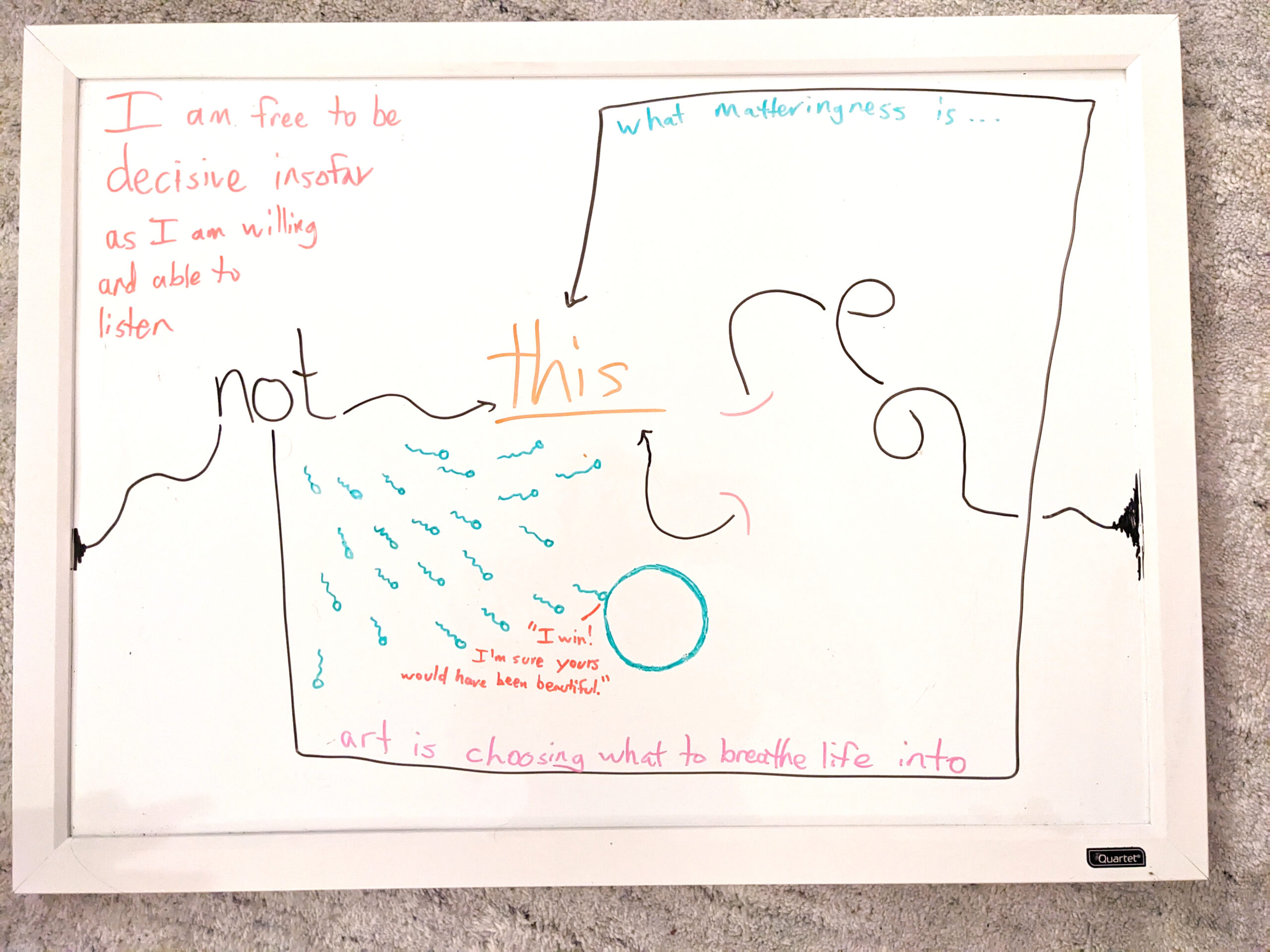
art is choosing what to breathe life into
this?
not this
this? not this. not this. this?
this.
this!
sometimes I get stuck because I have more urges than I know how to handle
“I want to write”
“no I want to take a shower”
“but before I take a shower I want to work out”
“but I’m still partway through writing”
“wait but I’m kinda hungry”
“wait no but I don’t want to eat if I’m about to work out”
…and on. and on.
so many urges. so many things to take care of. I can’t do all of them, not all at once. I can maybe take care of all of them eventually… but by then there will be more.
I can probably take care of what needs taking care of eventually, on some level of abstraction, somewhere up in my perceptual control hierarchy
even thinking a thought is sort of an urge
hi urge
you’re tryna take care of something
these urges are helpful
while it may be challenging when they’re all tugging in different directions
…these urges are all really helpful
honestly, they’re kinda… made of helpfulness
» read the rest of this entry »Another sequel to “Mindset choice” is a confusion. Here’s the first, which I wrote a year ago and published earlier this week: Mindset choice 2: expanding awareness.
I started exploring the implications of a simple question: what is within my power to choose?
This is something that we have to learn as infants and toddlers and kids—oh, I can choose to clench my fist… but I can’t choose to clench yours. Ooh… I can choose to look at something, but I can’t choose to make you look at something. Ah! I can choose to point at the thing, and maybe you’ll look, but I can’t directly steer your gaze or attention. In some sense, this is precisely where the boundary of self and other is located! And it’s also connected to how when we’re wielding a tool that works for us and it fades into the background, it becomes part of ourselves.
I can’t directly control you, although I might be able to invite or persuade or coerce you. And while I can’t quite control you, I can be trying to control you. Or I can be allowing you to be you and honoring the obvious-once-you-look-at-it reality that my choice ends at the edges of me. Society has historically involved a lot of the former, at great cost but also with meaningful results: lots of civilization was built by someone telling someone else what to do, on some level.
Then I considered that same structure, but applied internally to my own mind, and I realized that I have different parts that have different wills, and these parts also can’t control each other. They each have their own choice-making faculty, in this sense. To be clear, this line of thinking doesn’t require reifying these parts as persistent named entities as one might in IFS (Internal Family Systems). That’s an option, and might be helpful, but most fundamentally we’re just talking about some sort of subsystem that in a given moment is doing some perceiving, some wanting, some steering, etc.
And if those subsystems want something that’s compatible, I simply do it—no choice required.
But if one subsystem wants one thing and one wants another, and on a given level both aren’t possible—suppose part of me wants to keep writing and another part wants to go eat dinner—then neither system can simply enact its will since the other will oppose it. If one urge is particularly strong, eg because of a deadline or the smell of pizza in the oven, then that urge might overpower the other—it seems there are systems that track the size of urges as part of prioritizing and preventing such inner gridlock. Anyway, at that point, if the overpowered part releases and allows the first thing to happen, I’ll have full energy to do whatever it is I’ve found myself doing; if not, then I’ll experience friction and distraction—thoughts of food while trying to write, or thoughts of my blog post while eating. Or some more subtle indigestion of the mind and/or body.
What choice do each of these parts have, while in a conflict?
» read the rest of this entry »Another piece I wrote a year ago that I want to publish as a kind of snapshot rather than try to get it perfect. My ideas here keep evolving and any version that I come up with seems simultaneously confused and clarifying.
A sequel to “Mindset choice” is a confusion.
My Non-Naive Trust Dance framework and its clarity that mindset choice is confused was a huge source of relief for me, because I’d been feeling pressured to somehow make a choice that I couldn’t make, and which on some level I knew I couldn’t make.
However, I have also experienced a perspective from which it seemed to be true that in some sense your mindset is certainly a thing that only you can choose, and in another sense perhaps even the only thing you can choose. So how does that integrate with “mindset choice” being a confusion?
Here’s some thinking out loud on the topic. I’m aware of some limitations—this feels like it’s sort of dancing around the puzzle, not getting right to the heart of it.
One piece of the choice puzzle is: via expanding awareness.
This framing of expanding attention (awareness) as including both doing and not-doing is really interesting. One of the core skills of Alexander Technique is that of inhibition, the constructive noticing and not responding to stimuli. You may notice that you have the urge to yell at your boss, but you don’t.
But this is an active process, one that is continually renewing itself. You are aware of what you are doing in response to your boss (having a conversation) and what you’re not doing in your response to your boss (yelling). Through the skill of inhibition, your awareness includes both of these processes at once.
The expanded awareness is what allows this to happen. If your awareness were collapsed down to the yell response, you wouldn’t have any choice but to yell. By expanding out you are able to monitor a wider field of processes and choose the one you want.
— my friend Michael Ashcroft‘s newsletter. Emphasis mine in the last paragraph
And elsewhere:
» read the rest of this entry »